Victoria Bazir
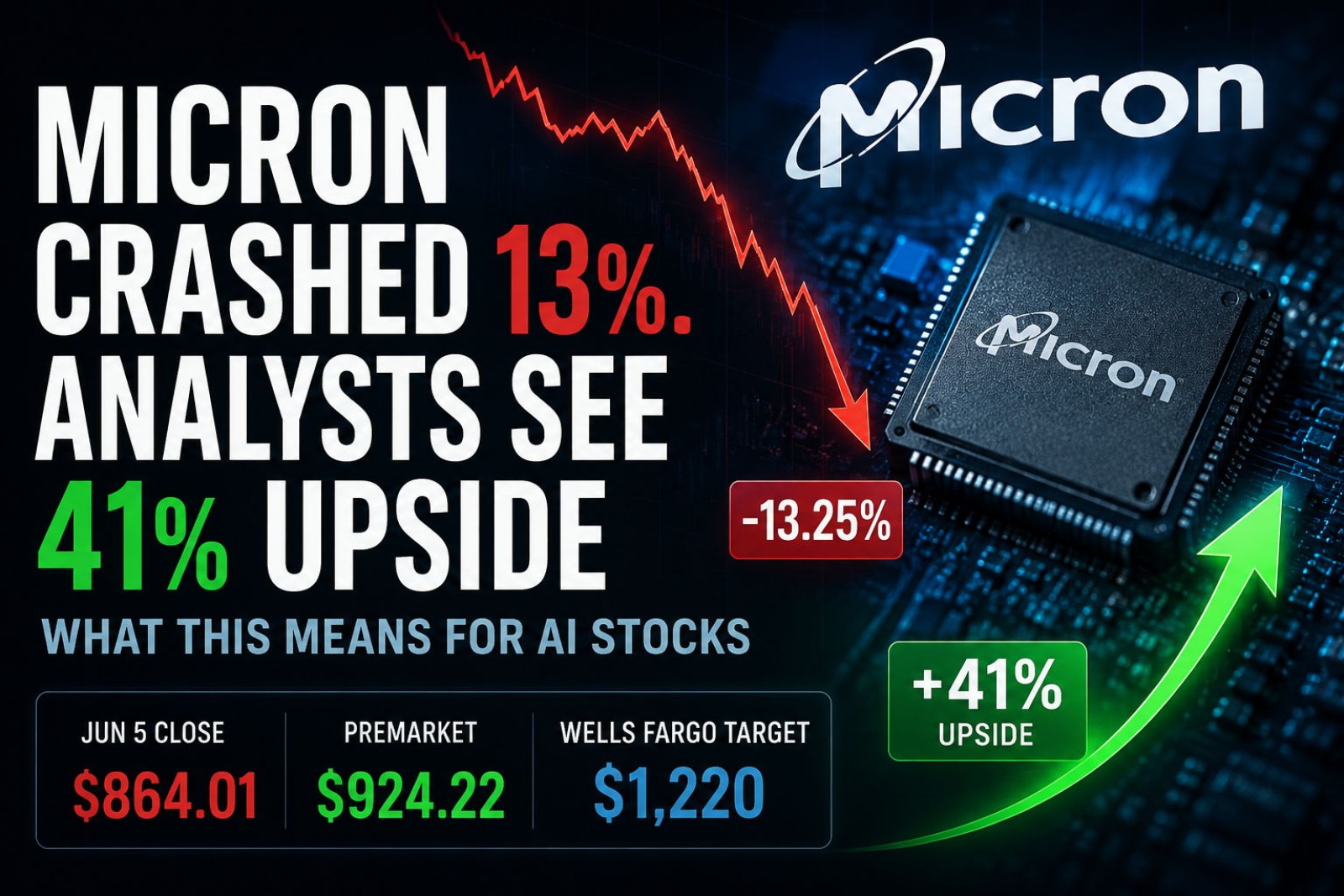
The move wiped out more than $130 per share in one day, yet buyers returned almost immediately. Premarket trading pushed the stock back above $924. The combination of a sharp sell-off, rapid recovery, and a new $1,220 price target from Wells Fargo offers a useful example of how AI-linked stocks behave when expectations become extreme.
Fast-Rising Stocks Rarely Move in Straight Lines
Micron gained more than 40% between May 22 and June 3. During that period, the stock climbed from $751 to $1,079.
Micron's June Pullback
| Date | Close |
| Jun 1 | $1,035.50 |
| Jun 2 | $1,064.10 |
| Jun 3 | $1,079.57 |
| Jun 4 | $996.00 |
| Jun 5 | $864.01 |
Viewed through that lens, the June decline looks less like a collapse and more like a reset after an unusually steep rally. Volume supports that interpretation. More than 76 million shares changed hands on June 5, making it one of the most active trading sessions of the year.
Why Micron Is Being Treated as an AI Stock
Micron does not build AI models. It does not operate cloud platforms. It does not sell chatbots. Its role is lower in the stack.
Modern AI systems require massive amounts of memory. Training large models and running inference workloads demands increasingly advanced DRAM and high-bandwidth memory solutions. Every new generation of AI hardware increases those requirements.
That has turned memory suppliers into direct beneficiaries of AI spending. The market is no longer valuing Micron as a traditional cyclical chipmaker. It is increasingly valuing the company as part of the AI infrastructure buildout.
What Wells Fargo's Target Really Signals
The headline number is easy to focus on. Wells Fargo raised its target price from $550 to $1,220. The more interesting detail is the timing. The revision came after one of Micron's worst trading days of the year.
Current Price vs Wells Fargo Target
| Metric | Price |
| Jun 5 Close | $864.01 |
| Premarket Recovery | $924.22 |
| Wells Fargo Target | $1,220 |
Analysts do not raise targets by more than 100% because of one quarter. Such revisions usually reflect a change in assumptions about a market opportunity. In Micron's case, that opportunity is AI-related memory demand.
The Long-Term Chart Tells a Different Story
A one-day decline dominates headlines. Long-term charts provide context.
Micron Long-Term Performance (2011–2026)
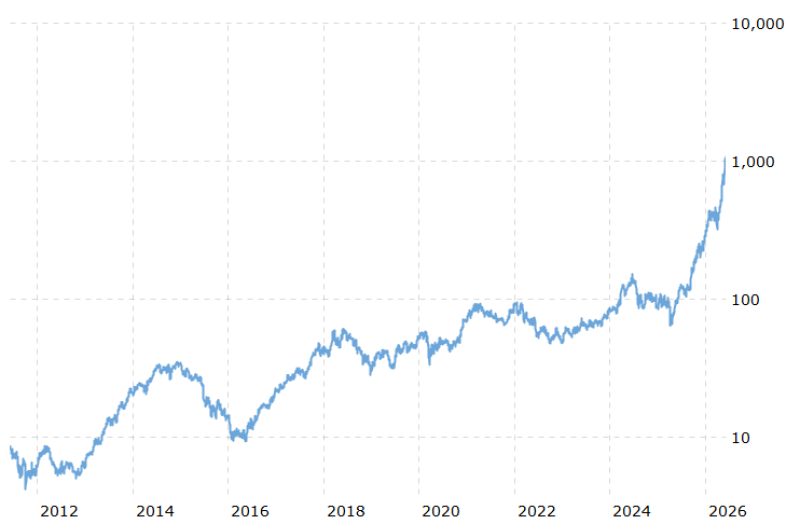
Micron traded below $10 during the early 2010s. The stock approached $1,000 in 2026. The path between those levels was not smooth. It included memory downturns, inventory corrections, inflation shocks, and semiconductor sell-offs. The current decline is large in daily terms. On a fifteen-year chart, it barely registers.
What This Episode Shows
Three numbers summarize the story:
- $1,079 — Micron's recent peak.
- $864 — the June 5 close.
- $1,220 — Wells Fargo's new target.
The gap between those figures explains why AI stocks remain difficult to analyze. Current prices reflect today's conditions. Valuations reflect expectations about where demand could be several years from now. Micron's recent sell-off did not change its position in the AI supply chain. What changed was sentiment.
The stock fell quickly because expectations had risen quickly. It recovered because the underlying growth narrative remained intact.
 Victoria Bazir