Marina Lyubimova
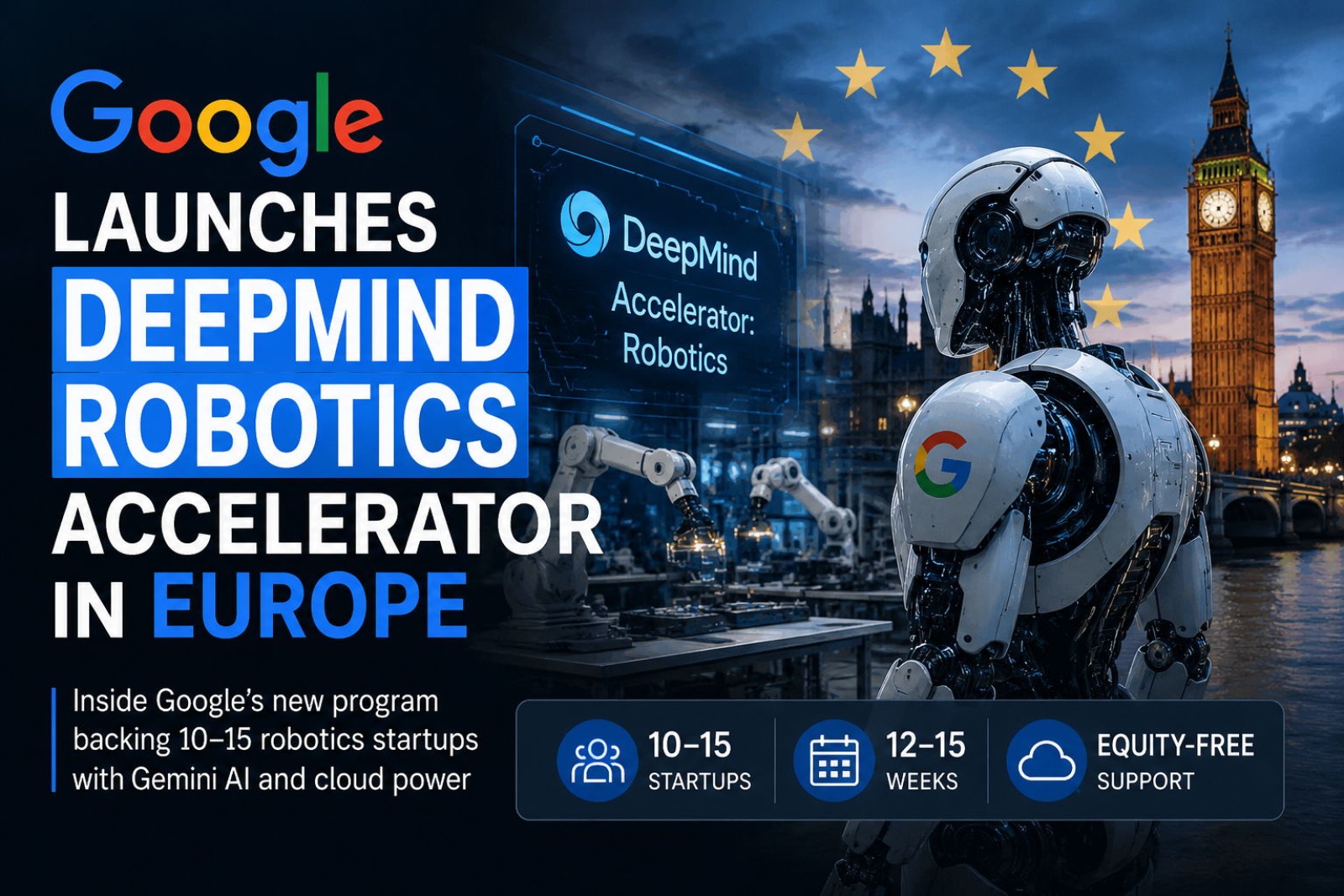
The newly launched Google DeepMind Accelerator: Robotics will accept just 10–15 European startups, providing access to Gemini Robotics models, engineering support, cloud resources, and direct mentorship from Google experts. On paper, it looks like another accelerator. In practice, it gives a small group of robotics companies early access to technologies Google wants deployed in the real world.
From Models to Machines
The AI industry spent the past three years scaling language models. The next challenge is different: getting those models to interact with physical environments. That requires more than generating text or code. Robots need to interpret surroundings, adapt to changing conditions, and execute actions with limited room for error. Google's answer is Gemini Robotics, a system designed to combine reasoning, vision, and action. The accelerator gives startups access to that stack while they build commercial products around it.
Inside the Program
Google is targeting early-stage robotics companies working across a range of applications and industries. The accelerator combines remote training, one-on-one mentoring, and in-person workshops over a 12–15 week period.
Selected startups receive:
| Feature | Details |
| Cohort Size | 10–15 startups |
| Program Length | 12–15 weeks |
| Mentorship | 1:1 expert sessions |
| Equity | None |
| AI Infrastructure | Google AI stack and Gemini Robotics |
| Cloud Credits | Available |
| Cloud TPUs | Available |
| Product Access | Early access to selected AI tools |
Applications opened on February 24 and closed on March 25. The cohort begins with a five-day event in London in June, followed by online training and mentoring through September. A three-day graduation event will conclude the program later that month.

Why London?
The choice of London is unlikely to be accidental. DeepMind was founded there, and the city remains one of Europe's strongest concentrations of AI research talent. It also provides proximity to robotics startups emerging from universities, industrial automation firms, and venture-backed AI companies across the region. The accelerator is formally European, but London remains the operational center.

A Different Kind of Competition
Most attention in AI still goes to model benchmarks and consumer products. Robotics creates a different contest.
Companies need models, hardware, sensors, compute infrastructure, simulation environments, and large volumes of real-world data. The barriers are higher and development cycles are longer. That is one reason major technology firms have increased their focus on physical AI over the past two years.
Google, Nvidia, Tesla, Figure AI, Agility Robotics, and Boston Dynamics are approaching the market from different directions, but all are working toward the same objective: making AI systems capable of operating outside a browser window.
Major technology companies are investing in AI systems designed to operate in physical environments rather than purely digital ones.
What Google Gets Out of It
The accelerator is equity-free, which removes the usual startup-program incentive. Google is not taking ownership stakes. Instead, it is increasing the number of companies building on its infrastructure.
That approach is familiar. Cloud providers, chip makers, and AI companies all benefit when developers adopt their platforms early.
For robotics startups, access to compute, AI models, and technical expertise can shorten development timelines. For Google, every successful company built on Gemini Robotics strengthens the ecosystem around its technology.
 Marina Lyubimova