Marina Lyubimova
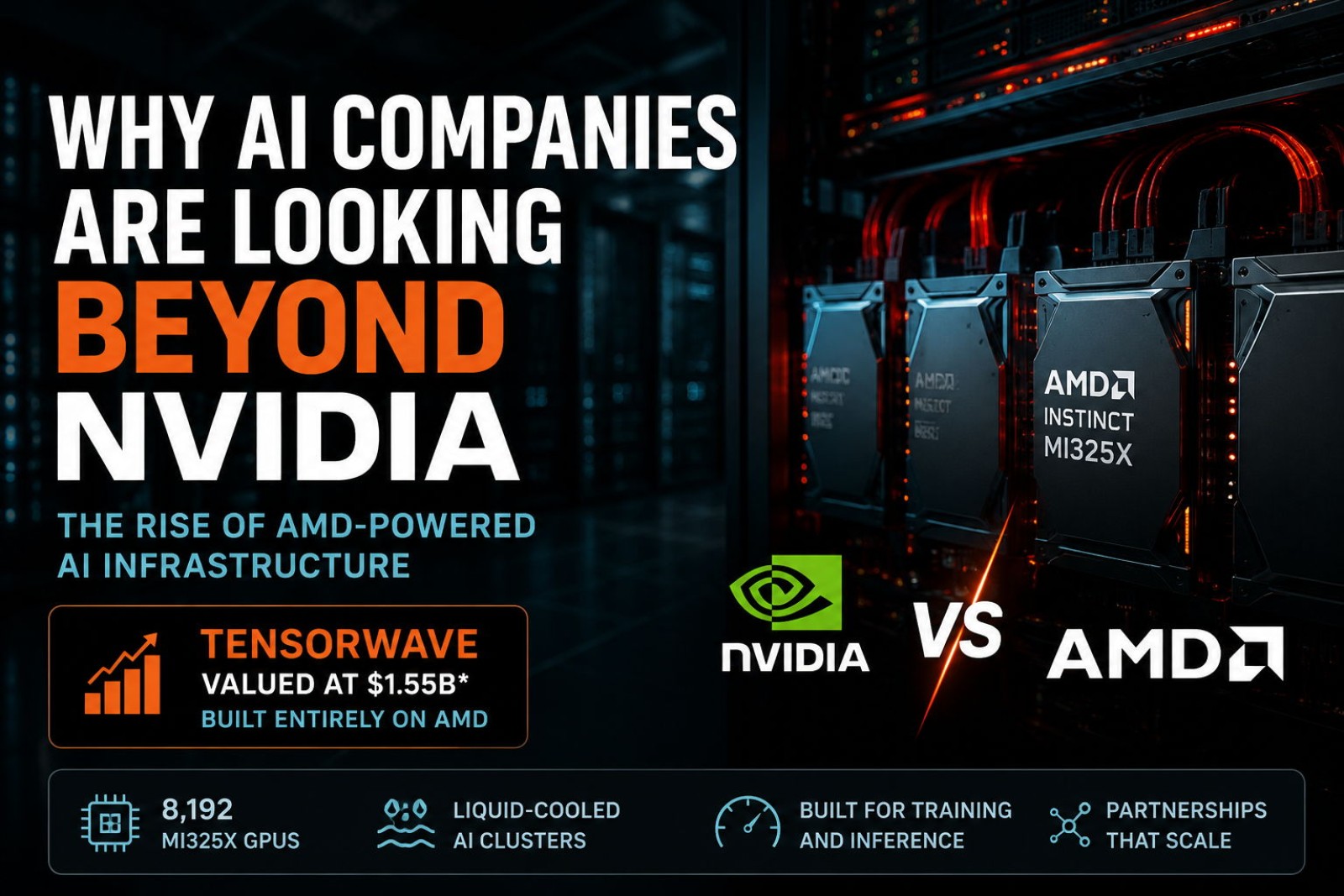
That dynamic is beginning to change. The reported $1.55 billion valuation of AI cloud provider TensorWave highlights a shift underway in the market. Rather than competing with Nvidia directly, a growing number of infrastructure providers are building alternative AI stacks around AMD hardware and open software platforms.
The story is not about one startup. It is about how the AI infrastructure market is becoming less dependent on a single vendor.
The Cost of a Single Ecosystem
Nvidia's leadership in AI extends beyond GPUs. CUDA became the default environment for AI development, creating a network effect that attracted developers, cloud providers, and enterprises. As AI adoption accelerated, that dominance translated into unprecedented demand for Nvidia hardware.
The downside of that success is concentration. Companies training models or deploying AI services often face the same challenges: limited hardware availability, high infrastructure costs, and dependence on a single technology stack. As AI workloads expand, reducing that dependence is becoming a practical business decision rather than a technical experiment.
Why AMD Is Getting More Attention
AMD's AI strategy is centered on two assets: Instinct accelerators and the ROCm software platform. The latest Instinct chips, including the MI325X, are designed for large-scale AI workloads. ROCm, meanwhile, has improved compatibility with major machine-learning frameworks, making it easier to deploy models outside the CUDA ecosystem.
Instead of competing for the same Nvidia hardware as everyone else, companies can build services around AMD systems while offering customers another option for AI training and inference. The approach remains a minority strategy, but it is attracting growing interest as AI demand continues to rise.
TensorWave's Bet on AMD
TensorWave committed to that strategy from the beginning. The company operates as an AMD-exclusive AI cloud provider and recently announced plans to deploy what it describes as the world's largest liquid-cooled AMD GPU cluster, consisting of 8,192 MI325X accelerators.
The market has responded positively. After raising $43 million in late 2024, TensorWave secured another $100 million in Series A funding led by Magnetar and AMD Ventures. Reports now place the company's valuation at approximately $1.55 billion.
Suggested chart data:
| Milestone | Value |
| SAFE Funding (2024) | $43M |
| Series A (2025) | $100M |
| Valuation (2026) | $1.55B |
The numbers suggest investors see demand for AMD-based AI infrastructure as more than a niche opportunity.
AI Infrastructure Is No Longer About GPUs Alone
Raw computing power remains essential, but large-scale AI systems depend on more than accelerators. Performance increasingly depends on networking, cooling, deployment speed, and system reliability.
That explains why TensorWave recently partnered with networking company Credo. The goal is to improve cluster efficiency and reduce the time required to move new AI infrastructure into production.
As clusters grow larger, these supporting technologies become critical. The companies that build complete infrastructure platforms may gain an advantage over those focused solely on hardware.
A More Competitive AI Market Is Emerging
Nvidia remains the industry's benchmark, but the market around it is becoming more diverse. AMD continues to expand its AI hardware lineup. Specialized providers such as Groq and Cerebras are pursuing alternative architectures. Cloud platforms are experimenting with different hardware strategies to reduce costs and increase flexibility.
TensorWave sits at the intersection of those trends. Its business is built on the assumption that AI demand will become large enough to support multiple infrastructure ecosystems.
| Company | Focus |
| Nvidia | GPUs + CUDA |
| AMD | GPUs + ROCm |
| Tensor | Wave |
| AMD Cloud Infrastructure | Core |
| Weave | AI Cloud Services |
| Cerebras | Wafer-Scale AI Systems |
| Groq | AI Inference Hardware |
The competitive landscape is still heavily tilted toward Nvidia, but alternatives are gaining visibility.
What This Means for AI Builders
The rise of AMD-focused infrastructure does not signal the end of Nvidia's dominance. It does signal that developers, startups, and enterprises have more options than they did two years ago.
For organizations deploying AI at scale, infrastructure decisions are increasingly based on workload requirements, software compatibility, availability, and cost - not just brand preference. That shift is creating space for new providers, new architectures, and new approaches to AI computing.
 Marina Lyubimova