Marina Lyubimova
They tend to appear in infrastructure data. Oracle's latest quarterly results offer a useful example. While the company reported record revenue and earnings, several less-publicized figures provide a clearer picture of how demand for AI computing capacity is evolving.
Where the Growth Is Actually Coming From
Not all cloud revenue tells the same story. Traditional cloud applications help companies run operations, manage data, and automate workflows. Infrastructure services, on the other hand, provide the computing power required to train and run AI models.
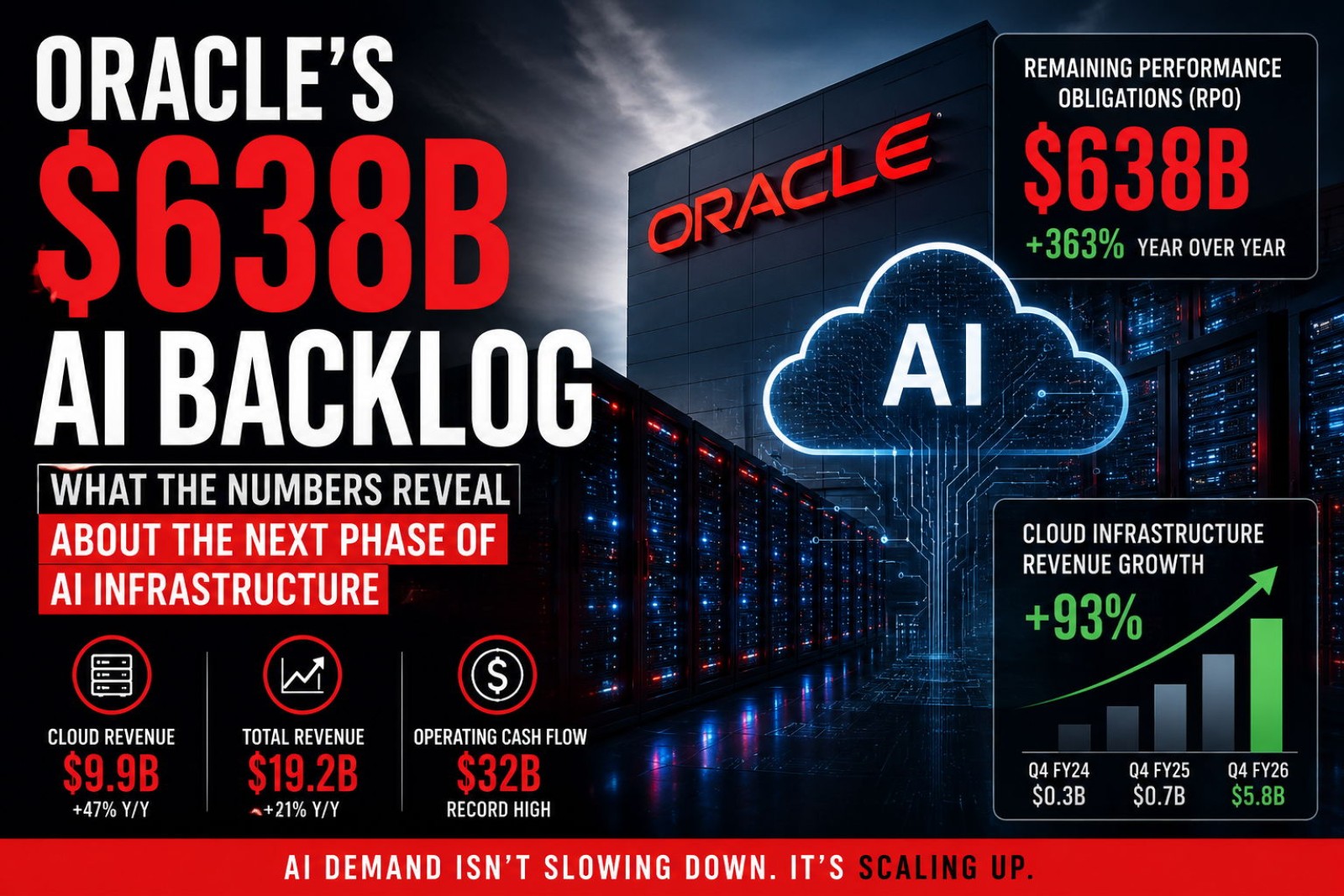
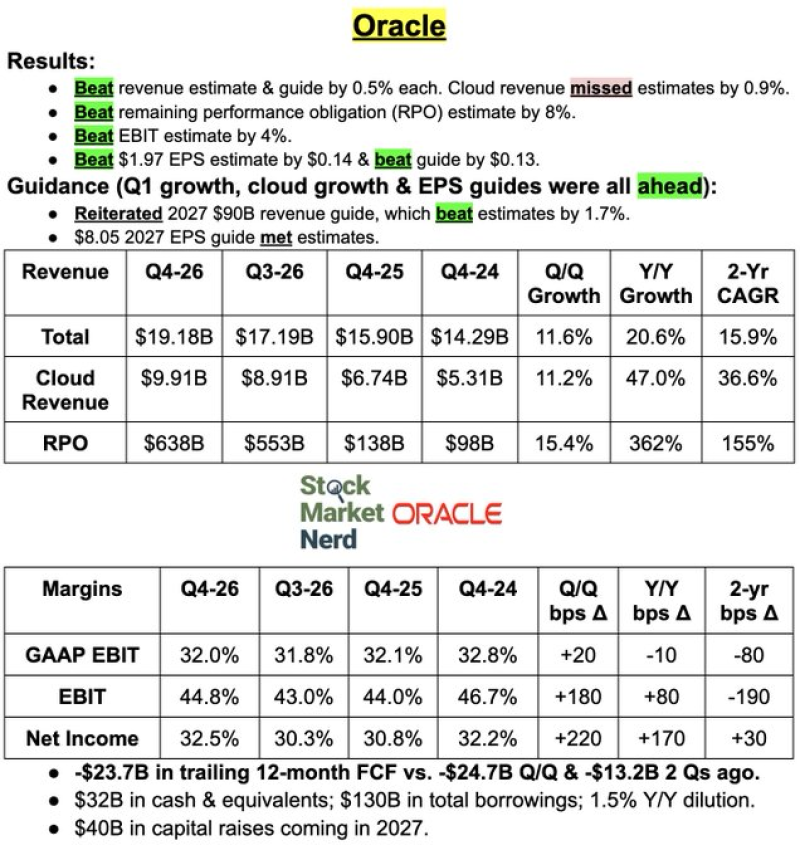
The difference became increasingly visible in Oracle's latest quarter. Cloud revenue reached $9.9 billion, up 47% year-over-year. Within that total, Cloud Infrastructure revenue jumped 93% to $5.8 billion, while Cloud Applications revenue increased just 10% to $4.1 billion.
- Cloud Infrastructure (IaaS): $5.8B (+93%)
- Cloud Applications (SaaS): $4.1B (+10%)
The numbers suggest that Oracle's fastest-growing business is no longer traditional enterprise software. Demand is increasingly concentrated in the infrastructure layer that supports AI workloads.
Demand Is Arriving Faster Than Revenue
Quarterly revenue shows what a company has already delivered. Contracted business often says more about what comes next.
Oracle's Remaining Performance Obligations (RPO) reached $638 billion at the end of the quarter, rising from $553 billion three months earlier and from $138 billion a year ago. That represents 363% annual growth.
- Q4 FY2024: $98B
- Q4 FY2025: $138B
- Q3 FY2026: $553B
- Q4 FY2026: $638B
For comparison, Oracle generated $67.4 billion in revenue during fiscal 2026. The scale of the backlog indicates that customer commitments are expanding considerably faster than revenue can currently be recognized. In practical terms, Oracle appears to be signing AI-related contracts faster than it can build the capacity required to fulfill them.
A Detail Buried in the Fine Print
One of the most interesting disclosures was not found in the headline results. Oracle revealed that many recent AI contracts involve customer prepayments for GPUs or customers supplying the hardware themselves. According to the company, those commitments now total approximately $75 billion.
That changes the economics of infrastructure expansion. Instead of financing every new datacenter entirely on its own balance sheet, Oracle is receiving direct support from customers eager to secure future computing capacity.
The arrangement reduces execution risk and highlights how aggressively large organizations are competing for AI resources.
Management Is Planning for More, Not Less
Forward guidance often reveals more about market conditions than the quarter that has already ended. Oracle expects total revenue to grow between 27% and 29% in the first quarter of fiscal 2027. Cloud revenue is projected to increase between 58% and 64%.
The company also reaffirmed its target of approximately $90 billion in revenue for fiscal 2027.
- FY2026 Revenue: $67.4B
- FY2027 Revenue Target: $90B
For a company of Oracle's size, that level of projected expansion is unusual. It suggests management sees no immediate signs of weakening demand across its cloud infrastructure business.
Why Cash Flow Tells a Different Story
Rapid growth does not automatically translate into immediate financial returns. Oracle generated a record $32 billion in operating cash flow during fiscal 2026. Yet free cash flow remained negative at approximately $23.7 billion because of massive investments in new infrastructure.
The company raised $48 billion through debt and equity financing during fiscal 2026 and expects to secure roughly another $40 billion during fiscal 2027.
Those figures illustrate the scale of the buildout currently underway. Datacenters, networking systems, power infrastructure, and GPU deployments require enormous upfront spending long before the resulting revenue appears on financial statements.
Reading the Bigger Picture
Viewed separately, each of Oracle's metrics tells only part of the story. Together, they point to a broader trend. Infrastructure revenue is growing nearly twice as fast as overall cloud revenue. Contracted business is expanding at a pace that exceeds current revenue growth. Customers are committing capital years in advance to secure AI capacity. Management is preparing for another year of rapid expansion despite record levels of investment.
Taken together, these developments suggest that the AI infrastructure cycle remains in a buildout phase rather than a maturity phase. Oracle's report is ultimately less about one company's quarterly performance and more about the scale of demand developing behind the scenes of the AI industry.
The applications may attract the headlines, but the infrastructure supporting them continues to grow even faster.
 Marina Lyubimova