Victoria Bazir
Recent data from Similarweb, Sensor Tower, and Statcounter shows that the AI ecosystem is expanding rapidly, creating new pathways between users and online businesses.
One Audience, Several AI Platforms
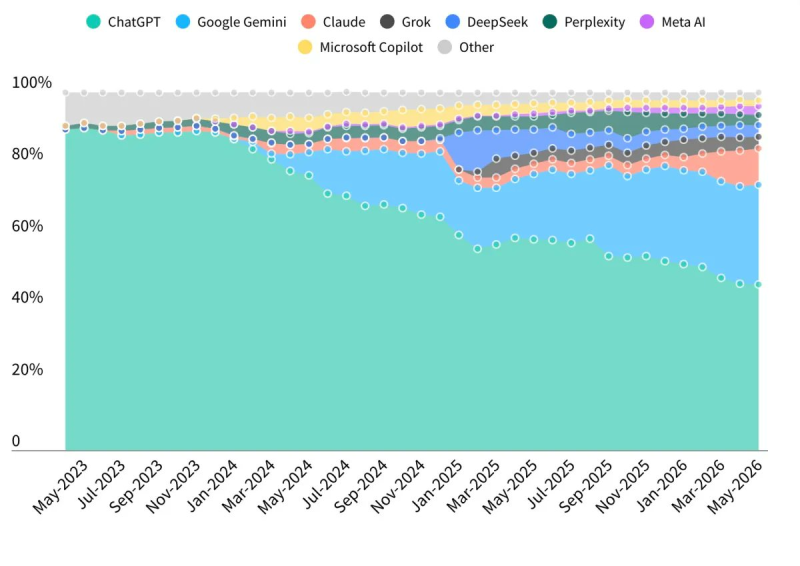
Three years ago, the AI assistant market was largely synonymous with ChatGPT. In mid-2023, the platform accounted for nearly 90% of usage among major AI chatbots.
That concentration no longer exists. By May 2026, ChatGPT's estimated share had fallen to roughly 43%, while Google Gemini approached 30% and Claude moved into double digits. Grok, DeepSeek, Perplexity, Meta AI and Microsoft Copilot collectively captured a growing portion of user attention.
The shift does not suggest users are abandoning ChatGPT. Instead, AI usage is spreading across multiple ecosystems. Consumers increasingly move between assistants depending on the task, device, or service they are already using.
Growth Rates Tell a Different Story
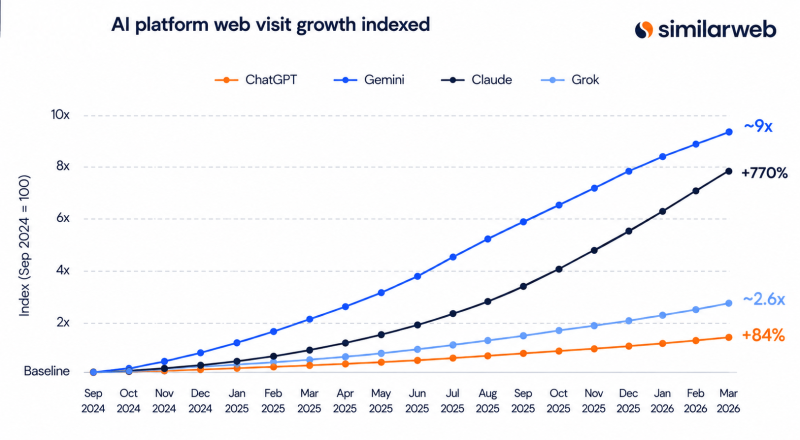
Market-share charts show how attention is distributed. Traffic-growth data shows where momentum is building.
Using September 2024 as a baseline, Similarweb found that Gemini's web traffic increased nearly ninefold by March 2026. Claude recorded growth of approximately 770%, while Grok expanded around 2.6 times.
ChatGPT also continued to grow, with web visits increasing 84% over the same period. These figures highlight an important distinction. ChatGPT's share may be smaller than it was two years ago, but its audience is still expanding. The difference is that competing platforms are growing at a much faster pace.
Google's distribution advantage is particularly visible. Gemini benefits from integration across Search, Android, Gmail, Workspace and Chrome, allowing the company to introduce AI features directly inside products already used by billions of people.
The Return of the Click
For much of the AI boom, publishers worried about losing traffic. Users received answers directly inside AI tools and had fewer reasons to visit external websites. Recent data suggests that dynamic may be changing.
According to Similarweb, ChatGPT referral traffic jumped 157.7% week-over-week after the platform expanded the use of clickable links inside responses. Referrals to homepages increased 357.4%.
The numbers indicate that AI platforms are becoming navigational tools as well as information tools. Instead of replacing websites entirely, they are increasingly acting as intermediaries between users and online destinations.
Fewer Visits, Stronger Intent
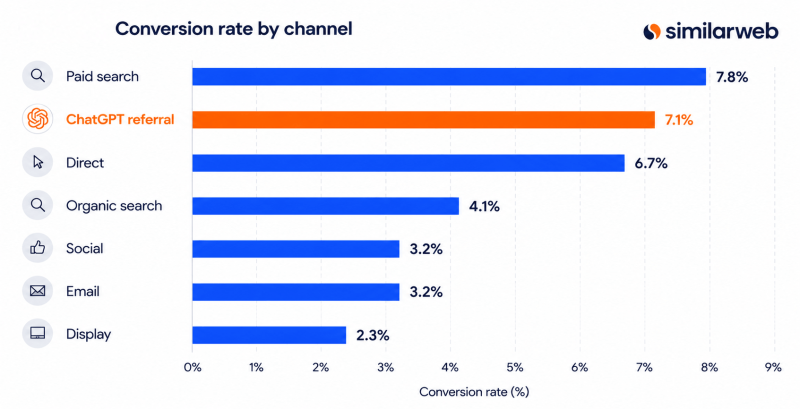
Traffic volume tells only part of the story. The quality of visitors often matters more than the quantity.
Similarweb's conversion data places ChatGPT referrals among the highest-performing acquisition channels:
| Channel | Conversion Rate |
| Paid Search | 7.8% |
| ChatGPT Referral | 7.1% |
| Direct Traffic | 6.7% |
| Organic Search | 4.1% |
| Social Media | 3.2% |
| 3.2% | |
| Display Advertising | 2.3% |
The gap between AI referrals and organic search is notable. Users arriving from ChatGPT appear to have already completed part of the research process before clicking through. By the time they reach a website, they are often evaluating a specific product, service, or source rather than browsing broadly.
That behavior produces conversion rates closer to paid-search traffic than traditional SEO traffic.
Which Sources AI Relies On
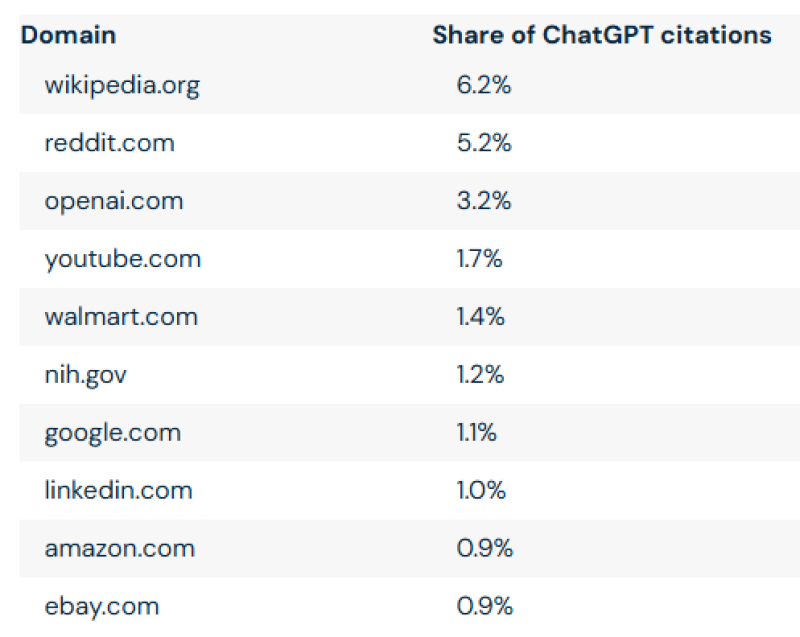
Citation patterns provide another signal about how AI systems evaluate information. According to Similarweb, the most frequently cited domains include Wikipedia, Reddit, YouTube, OpenAI, Walmart, NIH, LinkedIn and Amazon. The list is notable because it combines institutional authority with large collections of user-generated knowledge.
Wikipedia contributes structured reference material. Reddit provides discussions and firsthand experiences. YouTube adds visual demonstrations and tutorials. Although the sources differ, they share one characteristic: they contain information that is difficult to replicate through generic content production.
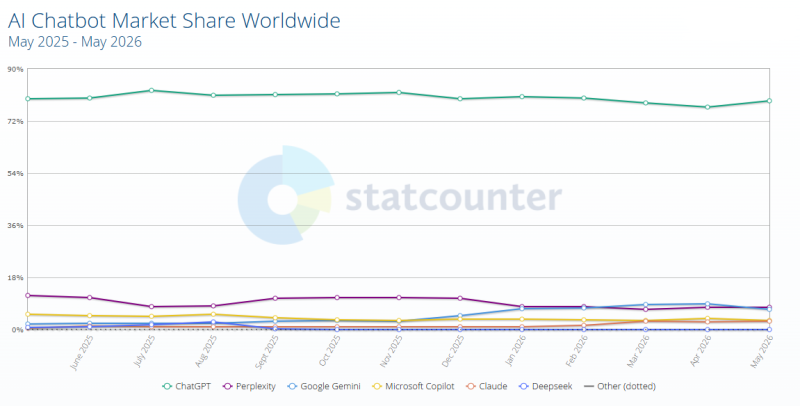
Readers comparing AI reports often encounter conflicting numbers. One dataset may show ChatGPT controlling roughly three-quarters of the market, while another places the figure closer to half. The difference usually comes down to measurement.
Some organizations track web visits. Others focus on app activity, monthly active users, downloads, engagement, or overall assistant usage. Each methodology captures a different aspect of the market.
The exact percentages vary, but the direction is consistent across datasets. ChatGPT remains the largest AI assistant, while Gemini, Claude and several smaller competitors continue to gain ground.
Search Is No Longer the Only Discovery Layer
Google rankings still matter. Social platforms still matter. Direct traffic still matters. What has changed is the number of places where discovery happens.
AI assistants are increasingly participating in product research, brand evaluation, content discovery and purchasing decisions. The result is a broader visibility landscape, where appearing in search results is only one part of the equation.
The companies benefiting most from this shift are not necessarily those generating the largest amount of content. They are the ones producing information that AI systems repeatedly choose to cite, recommend and link to.
 Victoria Bazir