Usman Salis

NIO's financial trajectory is back in focus as investors try to reconcile one of the more unusual situations in the EV space - a company delivering standout revenue growth while still posting significant annual losses. The stock remains a genuine debate on Wall Street, caught between aggressive growth expectations and the need for earnings to eventually catch up. According to The Analyst, the company looks undervalued relative to its growth outlook, with revenue set to rise sharply over the near term while the market holds its breath waiting to see if that expansion can finally translate into something durable.
NIO Revenue Climbs From $4.9B to $87.5B - Losses Tag Along
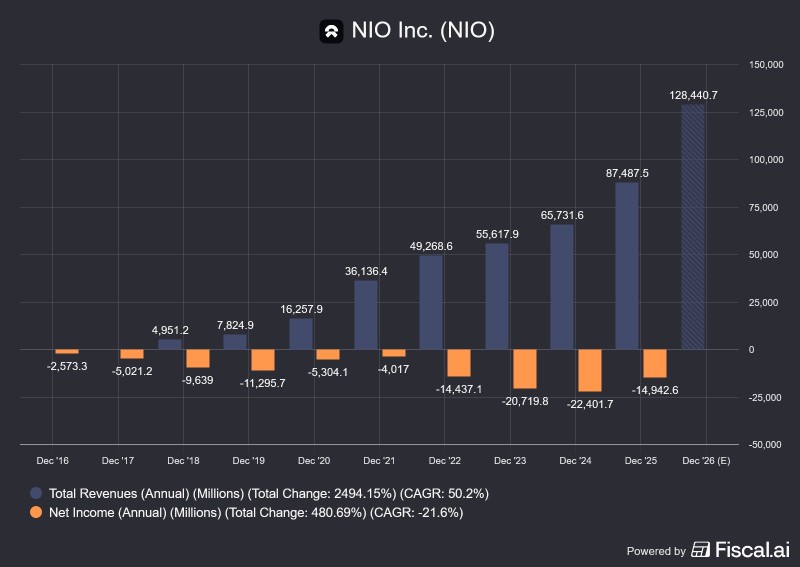
The numbers are hard to ignore. NIO's annual revenue has risen steeply over the period shown in the data, climbing from roughly 4,951.2 million all the way to 87,487.5 million - with 2026 estimates pushing that figure toward 128,440.7 million. That kind of trajectory is unusual even for high-growth automakers.
NIO is expanding at an unusual pace for an automaker - and the market hasn't fully priced that in yet.
But the other side of the ledger tells a different story. Annual net income stays negative throughout the same period, with estimated losses of 14,942.6 million projected for 2025 and the loss profile still visible heading into 2026. That is the core tension in this setup - the revenue line is clearly working, and the scale is building, but profitability is still a forward-looking story rather than a current reality. Any call that 2026 will definitely be NIO's first profitable year goes beyond what the current data actually shows.
Revenue momentum is visible now. Profitability still needs to be delivered - and that is what the market is waiting on.
Why the NIO Valuation Argument Keeps Coming Back
The bullish case for NIO has a specific logic to it. It is not about what the company has already proved on earnings - it is about the gap between NIO's growth profile and how the stock is currently being priced. The argument is that the market is not giving the company credit for what its scale could eventually support. That conversation has shown up repeatedly in recent technical coverage, where NIO has been described as building a base and consolidating around the $5 support zone - holding in accumulation rather than continuing in a straight downtrend.
That framing matters because it changes how you read the chart. If the stock is genuinely in an accumulation phase - absorbing selling pressure, finding a floor - then the revenue story starts to look like a setup for a longer-term move rather than a near-term trade.
The company has already proved it can grow revenue. What the market needs now is proof that growth can become durable earnings power.
NIO Stock Setup - What the Charts Are Showing
From a technical standpoint, NIO has spent a significant stretch trading at deeply depressed levels. Analysts watching the chart have noted that the stock has been holding in a $3 to $7 accumulation range with Stage 2 breakout potential - a structure that, in classic market cycle analysis, tends to precede larger directional moves when volume and fundamentals align.
More recently, momentum has shown some signs of life. NIO jumped 23% as the $7.50 breakout level came into focus, giving bulls something concrete to point to beyond the revenue projections. Whether that move marks a genuine shift or simply another false start within a longer base-building phase remains to be seen - but it's the kind of price action that tends to sharpen attention.
The Next Phase Isn't About Growth Alone
At this point, NIO does not need to prove it can grow revenue. The data already makes that case clearly. What matters in the next chapter is whether that growth can actually narrow the gap between expanding sales and persistent losses. Until that happens, the stock stays a debate rather than a consensus - a name with a compelling scale story that is still waiting for the earnings follow-through to match it.
The company has achieved visible, measurable scale. The market is now waiting to find out whether scale can become something that actually shows up on the bottom line.
 Usman Salis