Marina Lyubimova

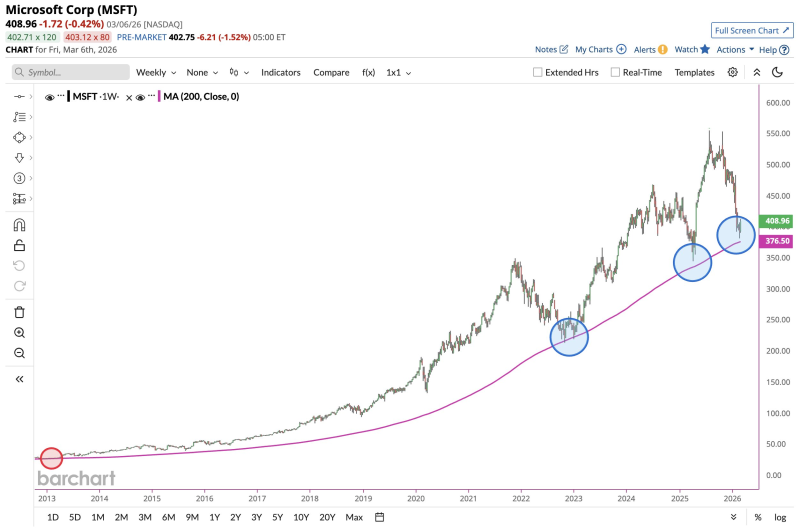
Microsoft stock is back in focus for long-term technical traders. With MSFT trading around $408.96 and the 200-week moving average sitting near $376.50, the gap between price and this key trend line is narrowing once again. According to data shared by Barchart, Microsoft has not posted a single weekly close below this level in more than 12 years.
That streak is worth paying attention to. The 200-week MA is one of the more reliable structural indicators for large-cap stocks, helping traders distinguish a genuine trend reversal from a routine pullback within a longer bull cycle.
MSFT Tested This Level in 2022, 2023, 2025, and Again in 2026
The weekly chart tells a consistent story. Each time Microsoft approached the 200-week average, whether during the tech selloff of 2022, the brief correction of 2023, or the more recent pressure in 2025 and 2026, buyers stepped in before the stock could close below the line. The support held every single time.
Long-term moving averages that hold across multiple market cycles often become important reference points for broader market sentiment.
Over the past decade, MSFT climbed from below $50 in the early 2010s to peaks above $500 in recent years. Through every correction along the way, the 200-week MA served as a floor, with price stabilizing near the level before resuming its upward trajectory.
Why the $376 Zone Matters for Microsoft's Long-Term Outlook
As Microsoft currently moves through a broader correction cycle, analysts are watching the $376 zone closely. Chart patterns are beginning to echo previous corrections, and the stock is approaching what many consider a multi-level confluence area, combining the 200-week MA with other valuation and technical support signals.
With MSFT revenue projected to nearly double to $440B by 2028, the fundamental backdrop remains strong. Whether the 200-week average holds for a 13th consecutive year may depend as much on macro conditions as on Microsoft's own business performance, but the technical track record is hard to ignore.
 Marina Lyubimova