Eseandre Mordi

Microsoft (MSFT) has shed nearly 25% of its value over the past six months, dragging the stock below the $400 mark. But beneath the surface of that selloff, the fundamentals tell a very different story, one of expanding margins, accelerating AI adoption, and a cloud platform growing its grip on enterprise infrastructure worldwide.
Operating Income Hits $140B While Expenses Stay in Check
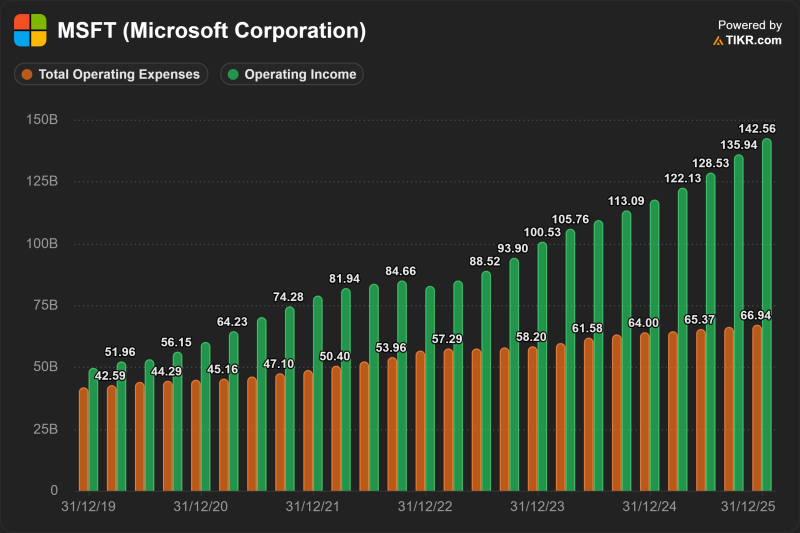
The numbers behind Microsoft's business remain compelling. Operating income has grown from roughly $50 billion in earlier periods to over $140 billion in the latest figures, while total operating expenses have climbed at a far slower pace, settling around $66 billion. That widening gap between income and costs reflects the durability of Microsoft's subscription model and the stickiness of its long-term enterprise contracts. As MSFT Stock Drops 12% as Microsoft Signals Higher AI Spending noted, near-term pressure has come partly from the scale of that investment, but the cost discipline embedded in the broader business remains intact.
Azure and Copilot Drive Microsoft's AI Expansion
Azure is increasingly the backbone of Microsoft's AI ambitions, evolving from a cloud platform into a full-stack AI infrastructure layer supported by NVIDIA and AMD chips alongside Microsoft's own Maia accelerator. The momentum is visible in adoption figures: Microsoft Stock News: Azure Growth Tops 40% in Strong Quarter captured just how fast the cloud segment is scaling. Meanwhile, Microsoft 365 Copilot has reached around 15 million paid seats and GitHub Copilot continues to add users, signaling that enterprise demand for AI tooling is no longer speculative.
Looking further out, Microsoft Eyes 7.3% Growth in 2026 as Azure Expands points to a CIO survey where 53% of workloads are already running on Azure, a figure that underlines the platform's structural advantage as enterprises deepen their AI commitments. The recent stock weakness looks less like a fundamental deterioration and more like a broader market recalibration around capital spending timelines. For long-term investors, the combination of profit growth, controlled costs, and accelerating AI adoption makes the current dip worth watching closely.
 Eseandre Mordi