Saad Ullah

IREN Limited has been one of the more closely watched names in the mining and AI infrastructure space, and the latest session gave traders something to talk about. After weeks of tight consolidation, the stock dipped, held its ground, and snapped back hard, all in a single day. Whether that momentum carries forward depends on what happens next at a key technical level.
The $39.50 Support Line Holds Again
After dipping to an intraday low of $38.94, the stock reversed sharply and closed at $42.36, gaining 5.95% on the day. The move came right off the $39.50 area that traders have been monitoring for weeks, with the daily chart showing price stabilizing around $39.48 before the push higher. The session opened near $39.19, which made the recovery and the strong close all the more notable.
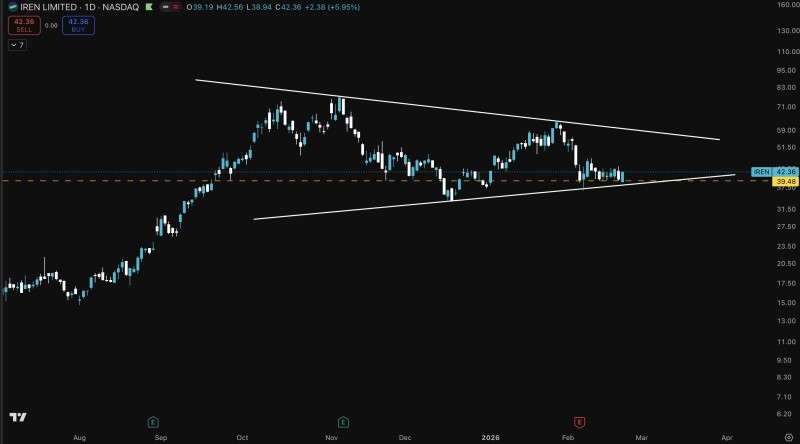
The rising support line has now absorbed multiple tests, each time seeing price recover and close well above the level. The chart is building what looks like a classic wedge breakout setup, with a descending upper trendline pressing against a rising lower boundary. Price has been coiling in the low $40s since the rebound, and the two trendlines are converging. That kind of compression typically precedes a sharp move in one direction.
Watching for a Breakout Above Descending Resistance
Some market participants have projected a potential move toward $80 plus, which would mean clearing prior swing highs by a significant margin. While the chart confirms the coiling action, timing and targets remain open questions. What is clear is that holding above a $39 support structure keeps the bullish case intact. The intraday dip was quickly reversed, and the close back above $39.50 removes the immediate downside concern.
Recent technical commentary has also pointed to IREN holding a demand zone near $43, which shows just how closely traders are tracking this consolidation range. Repeated support holds combined with tightening price action tend to build pressure. The next meaningful move will likely come when price either breaks through the descending resistance or falls back to retest the lower boundary. Both scenarios are worth watching closely.
 Saad Ullah