Artem Voloskovets

The chart shows a near-total collapse. From a peak valuation of roughly $14.5 billion in early 2021, Chegg’s stock has fallen from around $115 to nearly $1 - a drawdown of about 99% in five years. The decline is not gradual. It accelerates sharply beginning in late 2022 and continues into 2026, with no meaningful recovery.
The inflection point
The timing of the collapse aligns almost perfectly with the release of ChatGPT in November 2022.
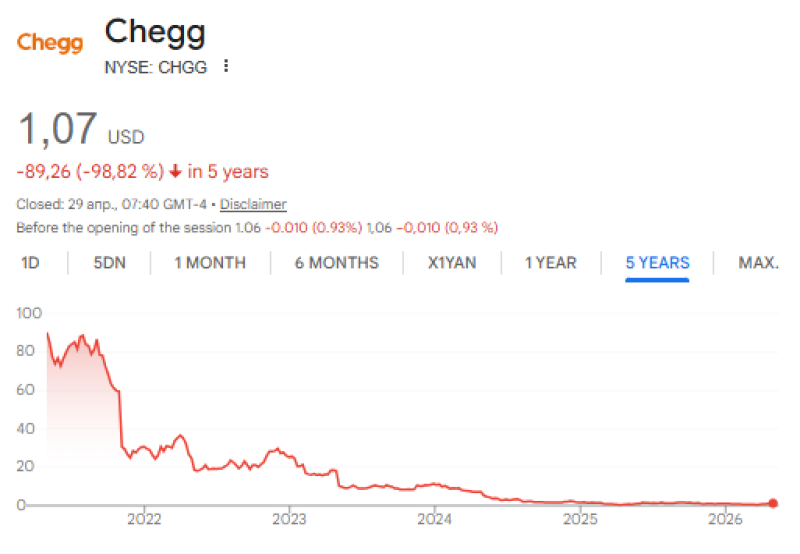
Within months, the impact became visible. In May 2023, Chegg’s CEO publicly acknowledged that ChatGPT was materially hurting the company’s performance. The market reaction was immediate: the stock dropped nearly 50% in a single day. That moment marked a structural break. The chart never recovered.
What actually broke the business
Chegg’s core product was built on a simple premise: paid access to a large, curated database of homework solutions. Over more than a decade, the company accumulated tens of millions of answers created by human experts.
Generative AI changed that equation instantly. What had been a gated, subscription-based resource became effectively free and infinitely scalable through AI systems. The value of Chegg’s core asset - its content library - was compressed to near zero.
Attempts to respond did not reverse the trend. Chegg launched its own AI-powered offering built on third-party models, but users increasingly chose to go directly to the source rather than pay for an intermediary layer. This dynamic reinforces how quickly AI is scaling into a dominant economic force.
A second-order effect: distribution loss
At the same time, the distribution advantage weakened. Search platforms began integrating direct answers into results, further reducing the need to visit Chegg at all.
The numbers behind the collapse:
- Subscriber base fell from roughly 5 million to under 3 million
- Revenue declined by nearly 50% year over year
- Multiple rounds of layoffs followed as the company attempted to cut costs
Even with restructuring efforts, the core model failed to stabilize.
The real signal:
Chegg is not just a struggling company - it is a case study. The key takeaway is that AI did not just compete with the product, it replaced it entirely. When a business is built on structured knowledge that can be replicated by generative models, the disruption is not gradual - it is immediate and irreversible.
Who could be next
Chegg’s collapse raises a bigger question: which businesses are most exposed to the same AI-driven pressure?
The highest-risk companies are those built around paid access to information that AI can now generate, summarize, tutor, translate, or search through instantly. That includes parts of online education, homework help, test prep, freelance content creation, basic legal templates, customer support outsourcing, and low-end research services.
The common pattern is simple: if the product is mainly a database of answers or repeatable knowledge work, AI turns it into a commodity. Companies with strong brands, proprietary data, regulated workflows, or human trust may survive - but everyone else faces the same question Chegg did: why pay the middleman?
 Artem Voloskovets