Editorial staff

The Brutal Math of Bank Runs and ATM Limits
Let's talk about the math of a bank run. Most Aussies assume their money just sits in a vault waiting for them. It doesn't. Banks operate on fractional reserves. They keep a tiny sliver of total deposits as physical currency. Right now, physical cash makes up less than thirteen percent of all consumer transactions in Australia. That means local branches stock less paper money than ever before. Add in the fact that hundreds of regional bank branches have shut their doors permanently over the last decade, and your odds look even worse.
If a severe bushfire or cyclone wipes out the main highway, panic sets in fast. The local Woolies manager can't process digital payments. They switch the registers to cash only. Every person in a ten kilometre radius suddenly realizes their plastic card is just a useless piece of trash.
They swarm the ATMs.
A standard ATM holds around a hundred grand. That sounds like a lot. It isn't. If five hundred panicked people want two hundred bucks each, the machine dies. That happens in about three hours.
Disaster Recovery Australia: Why Financial Independence Matters
The last time I tried to rely on the grid during a crisis was the 2022 Northern Rivers floods. The power dropped. The cell towers died shortly after. I walked to the nearest open bank branch to grab some extra folding stuff. A massive line snaked out the door. Angry customers yelled at the staff. By the time I reached the front, the teller looked completely exhausted. She told me people drained the vault hours ago. The regional manager locked the glass doors ten minutes later.
Here is the hard truth. The teams handling disaster recovery Australia wide are absolute legends. The SES and local emergency services perform daily miracles. They deploy choppers, rescue stranded families, and rebuild critical infrastructure faster than you can blink. But their primary job is saving lives. It is not restocking the local cash machines. Armaguard won't risk their staff or their trucks on flooded roads. You need to secure your own wallet so the professionals can focus on the heavy lifting. You stand completely on your own financially.
EFTPOS Outages and the Digital Payment Trap
Let's talk about the tap-and-go delusion. You probably walk around with just your phone in your pocket. Everyone does. You tap for a flat white. You tap for fuel at the servo. You feel incredibly modern. But that convenience is a massive trap. It relies on a fragile chain of technology. Your phone needs battery. The store needs power. The EFTPOS terminal needs a cellular connection. The bank server needs to instantly authenticate the transaction.
Remember the massive Optus outage in late 2023? Ten million people lost service. Trains stopped. Small businesses couldn't take card payments for an entire day. That was just a software glitch. Imagine a real physical disaster. If one single link in that chain snaps, your bank account balance means absolutely zero. You have no purchasing power.
Think about the psychology of the herd. When an emergency warning drops, normal people lose their minds. They rush the servos first. Then they hit Coles. They buy every bottle of water and every roll of toilet paper they can carry.
Why Bullion Dealers Secure Your Long-Term Survival
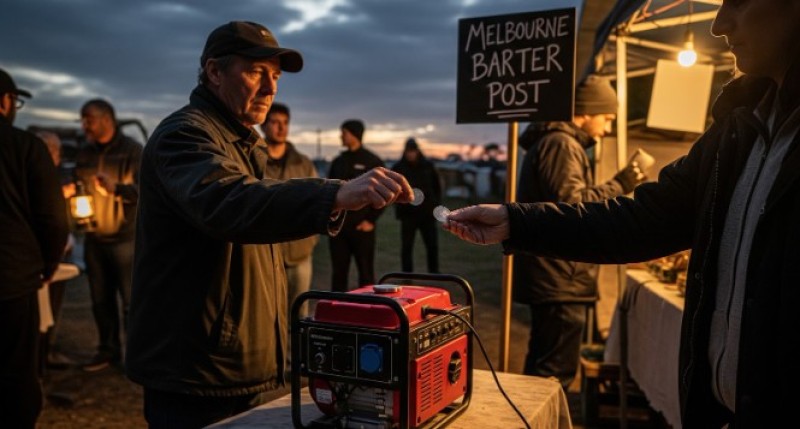
You might read articles claiming precious metals are useless in a crisis. Let me tell you why that advice is complete garbage. Yes, the stressed out teenager at the local shop wants a twenty dollar note for bottled water on day one. But what happens on day fourteen?
I know a few smart operators who frequent the Melbourne bullion dealers to stack fractional silver and gold coins. They understand something vital about prolonged emergencies. Paper cash gets you through the initial 72 hour panic. Hard assets protect you when the crisis drags on and local supply chains switch to a barter economy. I watched a bloke trade a few ounces of silver for a portable generator during a multi-week power outage. Real wealth always talks. The top tier bullion dealers provide highly liquid, globally recognized assets that insulate you against a total system failure.
How to Build Your Emergency Cash and Bullion Reserve
So what is the actual play here?
You build a two-step financial shield. Today. Not tomorrow. Not when the sky turns an ugly color.
First, you need small denominations of fiat cash for the immediate hit. Fifties, twenties, and tens. If the power grid fails, nobody has change. If you hand a bloke a hundred dollar note for twenty bucks worth of firewood, you just bought twenty bucks worth of firewood for a hundred dollars. He isn't giving you change.
Calculate your burn rate. Figure out exactly what you need to survive for 72 hours. You need fuel. You need food. You might need to bribe someone for a motel room if you have to evacuate. I keep exactly fifteen hundred dollars in a fireproof pouch. That gets me a full tank of diesel, three days of food, and a safe place to sleep.
Go to your bank tomorrow morning. Walk up to the teller. Ask for the money. They might ask you what it is for. Tell them you plan to buy a used tinny off Gumtree. They have no right to know anyway.
Take that cash home. Hide it well alongside your silver. I don't mean under the mattress. I mean inside a fake PVC pipe in the shed or up in the roof cavity. Put it somewhere so annoying to access that you will never feel tempted to use it.
I refuse to call this crazy prepper nonsense. This is basic personal responsibility. The system works great until the exact moment it stops. When a regional emergency hits, you want the government fixing the power lines, not worrying about your empty wallet.
You have a choice to make right now. You can trust a fragile digital network to stay alive during a crisis. Or you can become your own bank.
Get the cash. Buy the metals. Stop relying on systems that break when the wind blows too hard.
 Editorial staff