Saad Ullah
⬤ The S&P 500 (SPX) and the broader macro environment are entering a more fragile phase as multiple downside risks converge at once. Goldman Sachs research shows that individual shocks to 2026 GDP growth remain relatively contained in isolation, but their combined effect is growing harder to ignore. Rising oil prices near $100, softer payroll numbers, a roughly 5% equity correction, and early signs of stress in private credit markets are now developing in parallel rather than sequence.
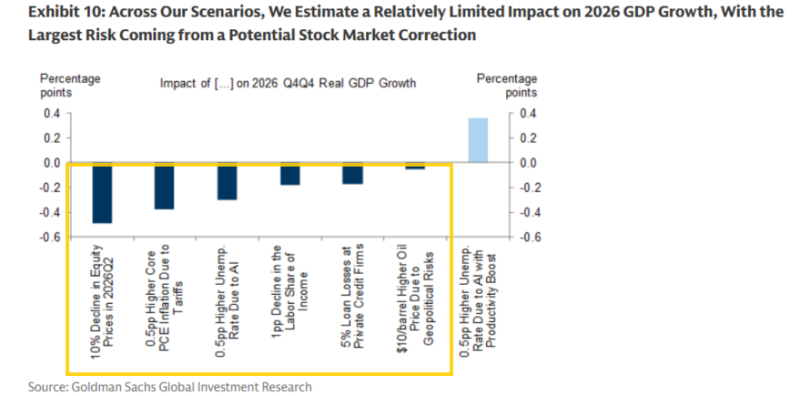
⬤ According to the Goldman chart, the biggest single drag on GDP comes from equity markets: a 10% stock decline could shave approximately -0.5 percentage points off growth. Tighter financial conditions, higher unemployment, falling labor income, and private credit stress each contribute smaller hits on their own. The risk is not any one shock but the accumulation of moderate pressures landing simultaneously, turning manageable headwinds into a meaningful macro drag.
No single factor appears sufficient to derail growth, but the interaction between equities, energy prices, and credit conditions is raising systemic vulnerability. Goldman Sachs macro research
⬤ Internal market data adds to the concern. Momentum has started fading near key resistance, with technical setups pointing to a possible 14-16% pullback. Breadth has also deteriorated, with fewer than 51% of S&P 500 stocks participating in recent moves, the weakest reading in five months. Elliott Wave analysis flags a likely A-B-C corrective phase following a strong 11-month rally. Together, these signals suggest the index is structurally more exposed than headline levels imply, with a corrective sequence building across multiple timeframes.
⬤ The current setup reflects a transition toward a stacked shock scenario: multiple moderate risks reinforcing each other rather than one dominant catalyst driving the move. Economic stability, in this environment, depends less on any single variable and more on whether overlapping pressures hit a threshold that shifts market and consumer behavior at the same time. That threshold, Goldman's analysis suggests, may be closer than the recent calm in volatility implies.
 Saad Ullah