Usman Salis

A decisive shift in rate expectations is forcing markets to reassess the path forward. The latest FedWatch data shows 0% probability of rate cuts through at least March 2027, challenging prior assumptions and reinforcing expectations of prolonged tight liquidity.
The Repricing That Changed Fed Rate Cut Structure
The chart highlights a clear concentration of expectations around the 350-375 bps range, with approximately 49% probability assigned to no change. What stands out is not just the clustering - it is the complete absence of any easing scenario.
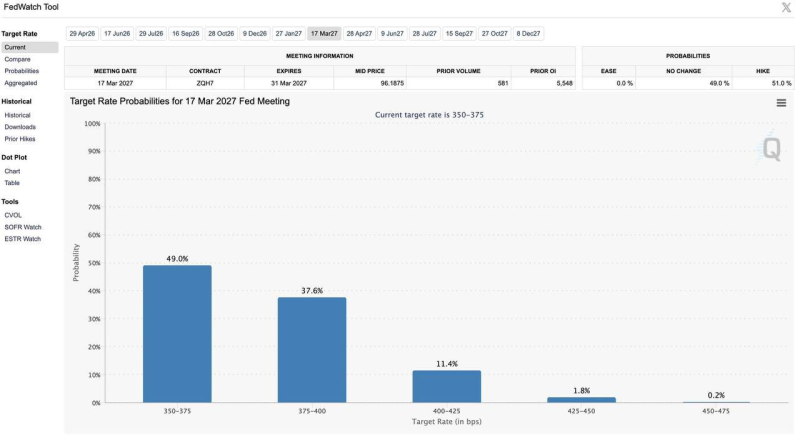
Instead of a balanced distribution, the structure is skewed toward persistence or tightening. A significant 37.6% probability is assigned to the 375-400 range, while smaller probabilities extend further into higher rate brackets - 400-425, 425-450, and even 450-475.
As Kamil noted, the disappearance of rate cuts changes the broader narrative entirely. The chart reflects this directly, showing that expectations are no longer distributed across easing outcomes - markets are converging on a narrow and distinctly one-sided set of possibilities.
Where Fed Rate Flexibility Disappears
Historically, rate expectation distributions tend to include at least some probability of easing. That flexibility has now vanished completely. Key observations from the chart make the shift hard to ignore:
- Zero probability assigned to rate cuts
- Majority of expectations concentrated at current levels
- Additional weight shifting toward higher rate brackets
Expectations are becoming more rigid, with less room for alternative scenarios to emerge.
Fed to Hold Rates in March: Markets Price 97.4% Probability of No Cut captured the earlier stage of this repricing, when a hold was already the dominant view but some residual easing probability still existed. That residual is now gone.
0% Rate Cut Probability Signals a Narrative Reset for Markets
The absence of rate cuts implies that liquidity conditions are expected to remain tight, removing a previously assumed support factor for risk assets. More importantly, the structure shows that expectations are no longer fluid - markets are aligning around a single dominant view with little room for deviation.
When markets fully price out one scenario, even small deviations can lead to significant repricing as positioning adjusts to a changing reality.
That rigidity has consequences. MSCI Asia Pacific Index Falls 6.3% as Taiwan Posts $7.9B Record Outflow and S&P 500 Sheds $3.1T in Three Weeks After Hitting October Peak both reflect how markets are already adjusting to a world where the Fed put is effectively off the table - and the scale of those adjustments is becoming difficult to ignore.
When markets fully price out one scenario, even small deviations can lead to significant repricing. The current setup leaves little margin for error - and even less room for surprise.
 Usman Salis