Usman Salis

European railway modernization is moving at very different speeds across the continent. According to fresh figures from EU Eurostat, Luxembourg stands alone as the only EU member state with 100% of its railway lines equipped with the European Train Control System (ETCS). The data maps out just how unevenly countries are upgrading their rail infrastructure to meet the bloc's interoperability targets.
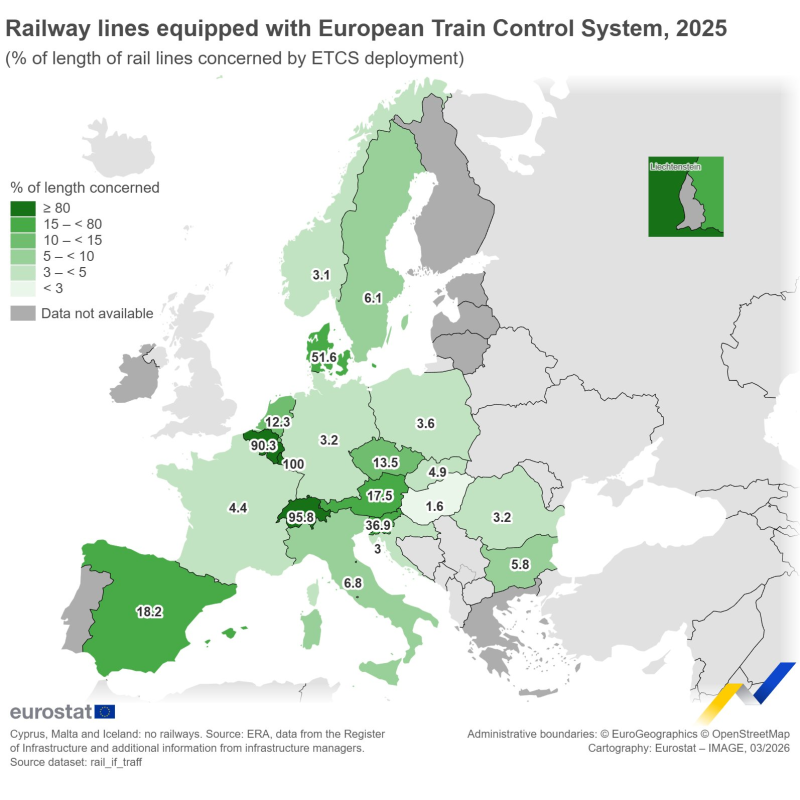
A handful of countries are clearly pulling ahead. Switzerland leads all European nations at 95.8% coverage, though it sits outside the EU. Belgium is close behind at 90.3%. Among EU members, Denmark has equipped roughly 51.6% of its network, while Austria reaches 36.9%. Spain (18.2%) and the Czech Republic (17.5%) reflect steady progress in central and southern Europe.
The current distribution of deployment highlights both the progress made in certain countries and the substantial modernization efforts still underway across the continent.
The gap to the laggards is stark. Hungary has equipped just 1.6% of its rail lines with ETCS, the lowest figure among all EU countries in the dataset. France (4.4%), Poland (3.6%), Romania (3.2%), and Bulgaria (5.8%) all sit below the 10% mark. These numbers make clear how much capital and coordination will be needed to bring large parts of the European network up to a unified digital standard.
ETCS is the signaling backbone of the broader European Rail Traffic Management System, designed to improve safety, boost network capacity, and make cross-border travel seamless. By replacing dozens of incompatible national systems with one digital standard, it sits at the center of the EU's long-term transport strategy. The 2025 snapshot shows real momentum in some corners of Europe, and a long road ahead in others.
 Usman Salis