Alex Dudov
In the United Kingdom, prices are increasing at a slower rate than what government statistics show. When Truflation tracks price changes as they happen, the data indicates that costs are falling more quickly than official records report. It is possible that the state of the economy is different from public descriptions.
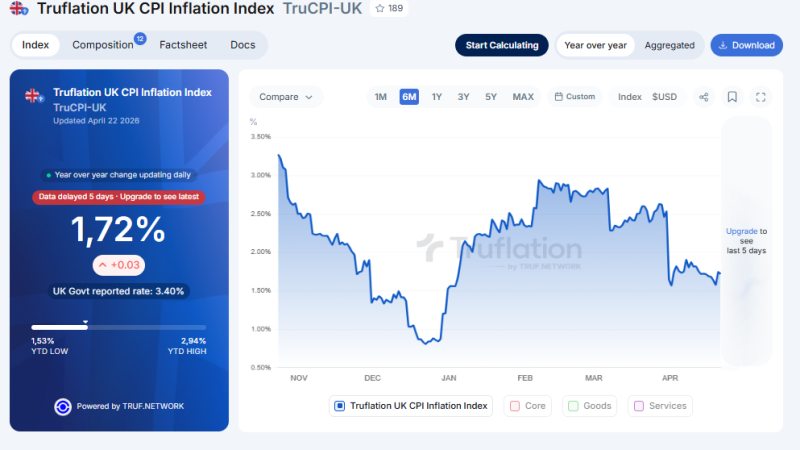
As the most recent records show, the real time rate for price increases in the UK is 1.72% - but the official rate is recorded at 3.4% - this gap exists because the traditional Consumer Price Index reports changes that happened in the past. To understand current situations, real time data is more responsive.
On the provided chart, the trend for price increases moves downward from the end of 2025. By early 2026 the rate dropped from approximately 3 % to less than 2 %. If the index reached a low point near 1 %, it later rose again. And it is now steady between 1.6% and 1.8% - this suggests that the forces that push prices higher are weak.
Due to those differences, it is likely that the internal movements of the economy are changing. Factors like lower costs for energy, the improved movement of goods and less desire from people to buy products are causes for this drop. By using real time data, the shifts are recorded with more speed.
If the actual rate of increase is near 2 %, this information affects what people expect from the Bank of England. For instance investors might expect interest rates to be lower if the trend stays the same. To confirm this individuals wait for official reports to match the current data.
There is still uncertainty because the real time data and official data do not match - but the current direction of the numbers shows that the pressure for prices to rise in the UK economy is becoming less intense.
 Alex Dudov