Alex Dudov

The euro area returned to a solid goods surplus in February, but the underlying trade picture remains uneven. According to EU_Eurostat, the euro area recorded an €11.5 billion surplus in February 2026, while the EU posted a €9.1 billion surplus.
Euro Area Trade Balance Stays Positive Despite Choppy Flows
The monthly year-over-year data for euro area goods exports and imports from February 2025 through February 2026 tells a more complicated story. Both series swing repeatedly between positive and negative territory, pointing to unstable trade momentum rather than a steady upward trend.
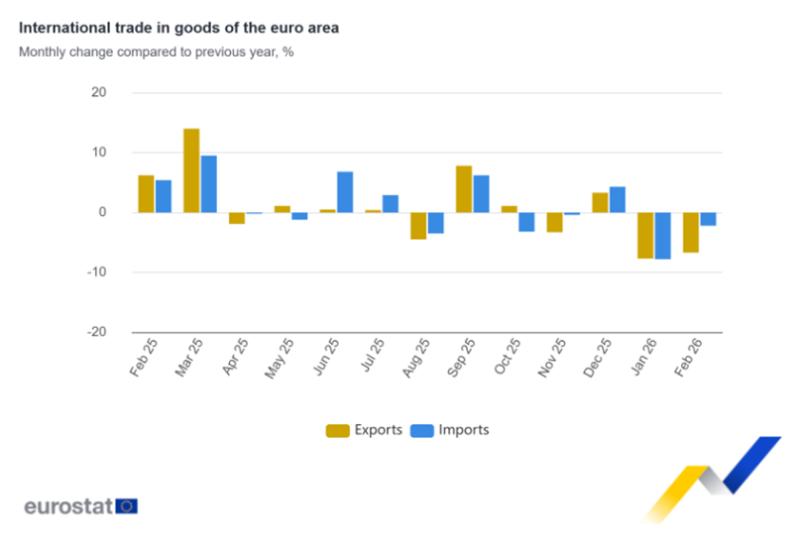
Exports were notably stronger in early 2025, especially around March, before fading and turning negative in several later months. Imports followed a similar path, with visible strength through parts of spring and summer, then weaker readings into late 2025 and early 2026.
The surplus reflects relative performance, not broad-based trade strength. A positive balance can coexist with weaker trade growth when imports fall faster than exports.
February 2026 Surplus Came With Softer Annual Growth in EU Trade
The latest data points, for February 2026, show both exports and imports contracting on a year-over-year basis. Even so, the euro area still posted a surplus. In practical terms, imports weakened more than exports, allowing the balance to remain positive even as overall trade activity softened.
This is precisely what makes the monthly breakdown important. It adds texture to the headline number by showing that February's surplus arrived after months of alternating gains and declines in both flows - rather than through a clean acceleration in external demand.
February's surplus came after months of alternating gains and declines in both trade flows, rather than through a clean acceleration in external demand.
The EU Trade Balance Drops $8B as Chemicals Double and Energy Stays a Drag analysis provides additional context on how sector-level shifts continue to shape Europe's external balance, with chemicals and energy playing an outsized role in monthly swings.
Why the €11.5B Headline Does Not Tell the Whole EU Trade Story
A surplus number on its own can be misleading. When both exports and imports are contracting, a positive balance simply means one side is shrinking faster than the other. That is not the same as a healthy expansion in external trade.
When both exports and imports are contracting, a positive balance simply means one side is shrinking faster than the other - that is not the same as healthy external trade expansion.
This softer, uneven structure is consistent with the broader trade reporting covered here recently. The EU Trade with Indo-Pacific Slows After Record Surge piece highlighted volatile import and export growth across one of Europe's key trading corridors, pointing to fragile external momentum that goes beyond any single monthly reading.
On a wider scale, the US $300B+ Services Surplus at Risk as EU Considers Retaliation report illustrates how cross-border imbalances and policy pressure are increasingly feeding into market narratives on both sides of the Atlantic.
For the euro area, the message is mixed: the bloc is still running a goods surplus, but the path underneath it remains volatile, and February's positive reading reflects weakness on both sides of the ledger rather than a recovery in trade demand.
 Alex Dudov