Victoria Bazir

Egypt's monetary landscape is raising red flags. The country's M2 money supply grew 18.7% year over year as of December 2025, while inflation is running at 11.9% annually - nearly double the upper bound of the central bank's official 3%-7% target range.
The numbers tell a familiar story for anyone watching how rising global money supply can influence inflation and financial markets. When liquidity expands faster than the economy can absorb it, prices tend to follow.
M2 Growth Still Above the "Golden Range" After Cooling from 2022-2024 Peaks
Egypt's money supply trajectory has been volatile. Between 2022 and 2024, M2 growth surged toward 25%-30% at several points, reflecting aggressive liquidity expansion across the economy.
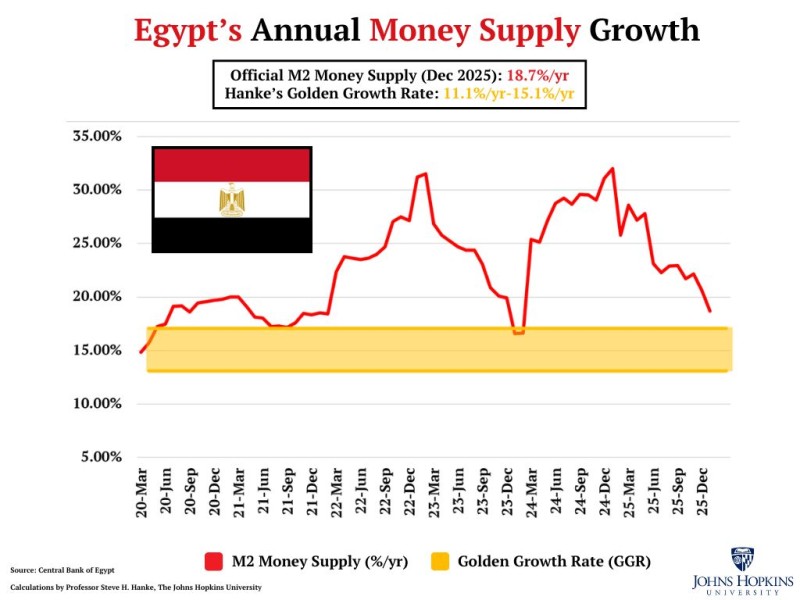
While 2025 brought some deceleration, the current 18.7% pace remains above what analysts call the "Golden Growth Rate" - a range of 11.1%-15.1% that economists associate with monetary conditions consistent with meeting inflation targets.
Egypt's inflation rate currently stands at 11.9% per year, exceeding the central bank's official inflation target range of 3% to 7% annually.
The gap between actual M2 growth and that benchmark matters. Studies examining the relationship between money supply growth and inflation stability consistently show that sustained monetary expansion above a country's golden rate tends to keep upward pressure on prices, even after a lag of several months or more.
Why Persistent Monetary Expansion Matters for Egypt's Economic Outlook
The broader concern is structural. Egypt is not alone in grappling with the downstream consequences of years of elevated money printing - but the persistence of above-target M2 growth makes a quick return to stable inflation unlikely without a meaningful policy shift. Research into how record levels of M2 liquidity affect economic conditions and asset prices suggests that even as headline inflation moderates, underlying price pressures can remain entrenched when monetary conditions stay loose.
For ordinary Egyptians, the gap between the 11.9% inflation rate and the central bank's 7% ceiling means real purchasing power continues to erode. Until M2 growth pulls back toward or below the golden range, bringing inflation durably within target is likely to remain a challenge for policymakers.
 Victoria Bazir