Eseandre Mordi
The XRP Ledger is moving to close one of the most persistent gaps in blockchain adoption by introducing zero-knowledge proof verification through an integration with Boundless. The update allows institutions to transact privately while remaining on a public network - directly targeting the transparency issue that has historically limited institutional participation.
A XRPL Privacy Upgrade Built for Institutional Use
As Diana noted, the XRP Ledger has integrated with Boundless, a zero-knowledge proving network, adding a layer of institutional-grade privacy to a public blockchain infrastructure.
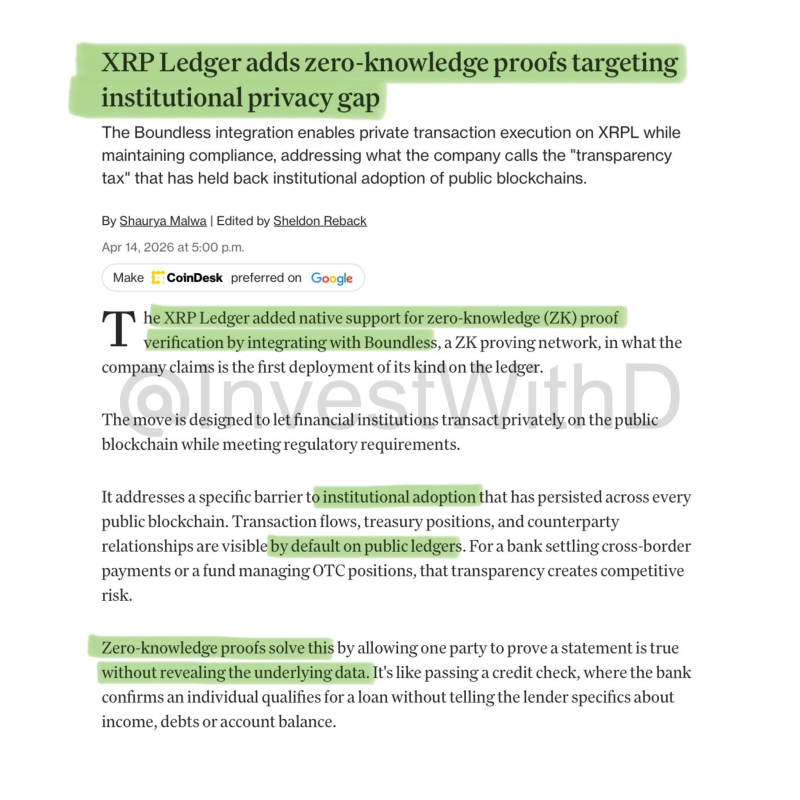
The core functionality centers on enabling transactions to be verified as valid, funded, and compliant without exposing sensitive financial details such as transaction amounts or counterparties. This marks a notable step in making public blockchain infrastructure more compatible with how large financial institutions actually need to operate.
The Transparency Problem Institutions Couldn't Ignore
A defining limitation of public blockchains is that transaction flows, treasury movements, and counterparty relationships are visible by default. For institutions operating at scale, this level of transparency creates real operational and competitive risks that have historically made full engagement with public blockchains difficult to justify.
The integration addresses this directly by adding a cryptographic layer that simultaneously provides:
- Proof of validity
- Proof of sufficient funding
- Proof of compliance
All without revealing the underlying data publicly. Zero-knowledge proofs enable one party to prove a statement is true without disclosing the underlying information - often compared to confirming creditworthiness without exposing full financial records.
A More Focused XRPL Institutional Direction
This development is aimed specifically at institutional adoption. It does not imply immediate capital inflows or guarantee large-scale usage - but it removes a key structural barrier that has prevented institutions from fully engaging with public blockchains.
XRP Ledger adoption expands shows how the ZK privacy integration fits into a broader pattern of infrastructure development on XRPL, where regulatory registration, platform completion, and now cryptographic privacy are advancing together rather than in isolation.
By enabling privacy while maintaining compliance, XRP Ledger becomes more aligned with how traditional financial systems operate - where sensitive data is tightly controlled rather than openly broadcast. Ripple's 500+ bank partnerships provides the demand-side context for why this privacy upgrade matters at scale - with hundreds of banking relationships already in place, the ZK integration directly addresses the compliance and confidentiality requirements those institutions bring to any blockchain engagement.
XRP Community Day adoption strategy adds context around how XRPL's 2026 roadmap has been building toward exactly this kind of institutional-grade infrastructure development - making the Boundless integration a strategic milestone rather than an isolated technical update.
 Eseandre Mordi