Victoria Bazir

Ethereum is entering a more fragile phase. ETF flows have turned decisively negative, with the latest session printing a $92.5 million outflow. According to analyst Ted, this shift points to growing distribution pressure — particularly as major issuers like BlackRock contribute heavily to the selling. And it matters, because ETF flows have become one of the strongest real-time indicators of institutional conviction in ETH.
The ETH ETF Flow Structure That Quietly Rolled Over
Earlier in March, flows were mixed — some sessions posted strong inflows, giving the impression that demand was holding up. But that picture changed fast.
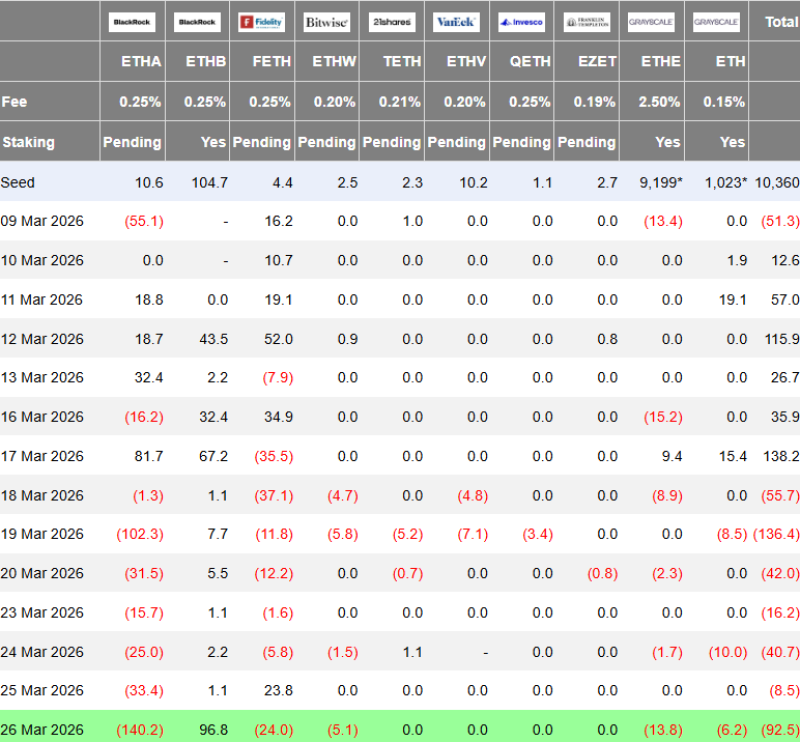
By mid-to-late March, negative flows started clustering rather than appearing sporadically. The final session confirmed a sharp acceleration, with total outflows landing at $92.5 million. As Ted noted, this isn't an isolated print — it follows a sequence of weakening inflows and failed attempts to rebuild momentum.
The shift points to growing distribution pressure — particularly as major issuers like BlackRock contribute heavily to the selling.
Earlier large positive entries and "Seed" allocations now contrast sharply with the current distribution phase, showing just how quickly sentiment can flip.
Ethereum ETFs Accumulate 90,000 ETH Over Three Weeks — a reminder of how different the flow picture looked just weeks ago.
BlackRock Drives $43.2M of the Latest ETH ETF Selling
The concentration of outflows is one of the most important signals here. BlackRock alone accounted for approximately $43.2 million in selling — making it the dominant force behind the latest move.
This aligns with a pattern that has played out before. Ethereum ETFs See $21.3M Net Outflow After BlackRock Exit — similar dynamics have triggered broader outflows across ETH products in previous episodes.
What makes this week different is that multiple issuers posted negative flows at the same time. That rules out fund-specific repositioning. It points to something broader — a coordinated withdrawal of capital from the ETH ETF space.
Multiple issuers posting negative flows simultaneously reinforces the idea that this is not fund-specific repositioning but a broader withdrawal of capital.
ETH ETF Distribution Pattern Replaces Accumulation
The inflow-to-outflow dynamic tells the clearest story. Positive days still exist — but they are smaller in size, less consistent, and quickly offset by larger red sessions. That imbalance creates a structurally bearish flow pattern.
Even when inflows appear, they fail to build momentum or reverse the trend. Historically, markets driven by ETF flows tend to weaken when outflows cluster rather than appear randomly. Large, sustained redemptions — like those seen in previous ETH ETF drawdown cycles — typically signal deeper repositioning.
The data now reflects:
- Persistent net outflows across multiple issuers
- Increasing size of red days toward the end of the period
- No strong inflow response even after price declines
This is distribution, not panic. The market isn't seeing abrupt exits — it's seeing a steady, deliberate reduction in exposure.
In crypto markets, ETF flows have become one of the strongest drivers of directional bias, often dictating whether price action stabilizes or continues trending.
ETH ETFs See $600M Weekly Exodus as BlackRock Pulls Back — for broader context on how this trend has been building.
 Victoria Bazir