Marina Lyubimova

A fresh SEC filing has brought BitGo back into the spotlight, but the headline event isn't really the filing itself. It's what the filing reveals about how concentrated the business actually is. When nearly half of your operating plan's value traces back to a single asset, that's not just a disclosure item. It's a market signal.
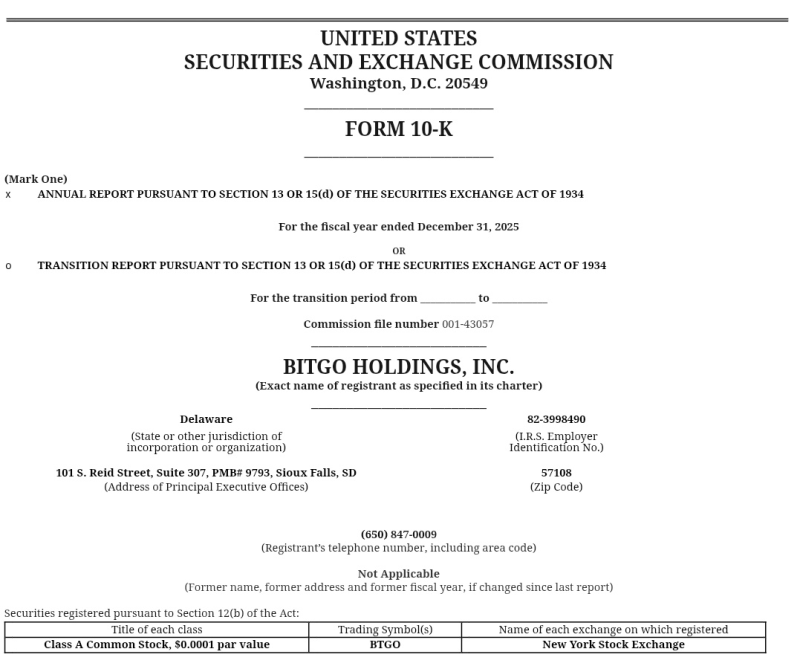
ChartNerd flagged the 10-K, noting the asset breakdown buried beneath the annual report cover page.
BTGO 10-K Shows BTC at 49.2% as 5 Digital Assets Drive 80% of BitGo's Operating Value
The filing covers fiscal year ended December 31, 2025, with BTGO listed on the New York Stock Exchange. That public-company frame matters right now, because it places BitGo inside a disclosure framework where transparency around exposure is as closely watched as revenue growth.
The filing positions BitGo squarely within the public-company disclosure framework, where transparency around exposure matters as much as growth itself. - ChartNerd
The asset breakdown is where the real story sits. Roughly 80% of BitGo's operating plan value is tied to just five digital assets, and the hierarchy within that group is steep:
- BTC: 49.2%
- SUI: 11.3%
- ETH: 10.1%
- SOL: 5.4%
- XRP: 4.7%
Bitcoin's share is nearly four times the next asset on the list. That's not diversification. That's concentration with a few secondary names attached. It mirrors the broader BTC dominance structure visible across the crypto market, where capital tends to cluster at the top rather than spread evenly across the ecosystem.
SUI Ahead of ETH in BTGO Mix Points to Newer Demand Pockets Inside BitGo's Framework
The secondary tier is notable for its own reasons. SUI appearing ahead of ETH is the kind of detail that doesn't get much attention in a headline scan but says something specific about where BitGo's platform activity may actually be clustering.
The presence of SUI, SOL, and XRP highlights how newer ecosystems continue to capture pockets of activity, even as Bitcoin maintains its dominant position in the operating mix.
This isn't a static picture of legacy crypto exposure. The inclusion of SUI and SOL alongside ETH and XRP suggests BitGo's business mix is tracking genuine platform usage rather than just parking assets in the most recognized names. Solana's on-chain activity and DEX volume expansion helps explain why it maintains relevance inside frameworks like this one, even at a relatively modest 5.4% share.
Still, the gap between BTC and everything else is the defining feature of the entire disclosure.
BTGO Crypto Concentration Risk Ties Performance Sensitivity Directly to Bitcoin's Behavior
That concentration cuts both ways for public investors. When Bitcoin is liquid, institutionally active, and trending, a business with this kind of exposure benefits directly. When BTC comes under pressure, there's limited cushion from the secondary assets to absorb the impact.
Institutional capital rotation patterns between BTC and ETH add another layer here. ETH sitting at just 10.1% in BitGo's mix, behind SUI, suggests the company's operating exposure may not be rotating in sync with every institutional capital flow. It's a Bitcoin-anchored business with selective secondary exposure, and the market will likely price it that way.
The 10-K is a compliance event. The asset breakdown is the actual signal.
 Marina Lyubimova