Marina Lyubimova

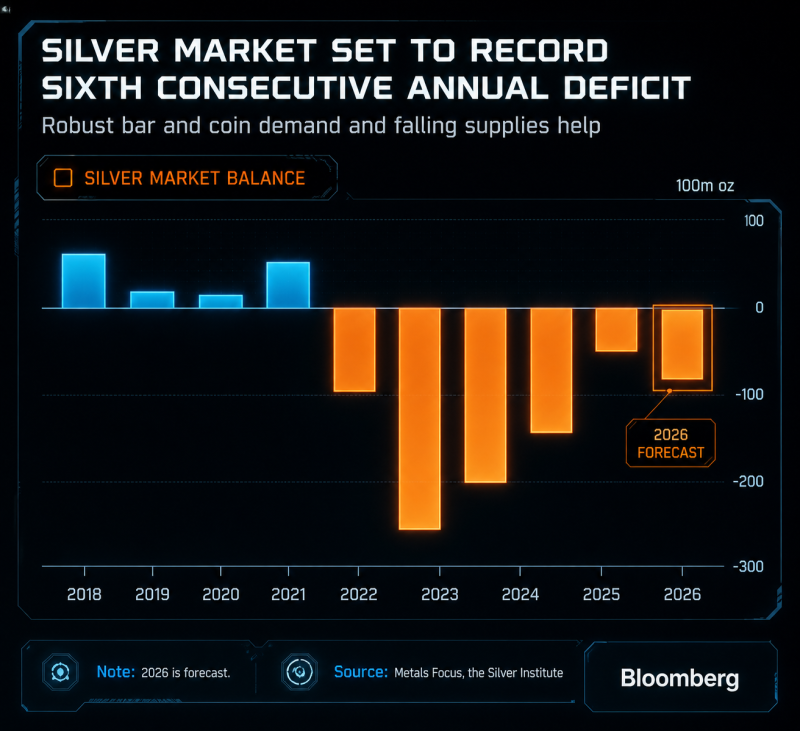
According to estimates referenced by Bloomberg, the silver market deficit is projected to widen to 46 million troy ounces in 2026, up roughly 15% from the previous year. This marks a notable reversal from expectations that softer demand would help rebalance the market.
A Growing Deficit - Even as Demand Cools
At first glance, the silver market appears to be easing. Industrial demand one of the key drivers of global consumption is expected to decline by around 3% year over year, falling to its lowest level in four years.
Under normal conditions, weaker industrial activity would reduce pressure on supply. But that is not what is happening. Instead, the deficit is widening. This contradiction is what sets the current cycle apart.
The explanation lies in the structure of demand. While industrial usage is softening, investment demand is rebounding sharply. Bar and coin purchases are projected to rise by approximately 18% in 2026, supported by renewed interest from retail investors, particularly in the United States. This shift means that even though one pillar of demand is weakening, another is strengthening enough to keep the market firmly in deficit.
Supply Is Not Responding
At the same time, supply remains constrained. Global silver production is expected to decline by around 2% in 2026, despite relatively strong prices in previous years. This suggests that mining output is facing structural limitations rather than cyclical ones.
Unlike other commodities, silver supply cannot quickly scale in response to price signals. Many projects require years of development, and a large portion of silver production is tied to byproduct output from other metals such as copper and zinc. As a result, even modest disruptions or delays can have a prolonged impact on overall supply.
The Real Story: Six Years of Continuous Depletion
The deeper issue is not just the 2026 deficit - it is the accumulation of deficits over time.
Since 2021, the market has consumed approximately 762 million troy ounces more silver than it has produced. That cumulative drawdown has significantly reduced available inventories and left the market with less flexibility to absorb future shocks.
This is what distinguishes the current cycle from previous ones. The market is no longer dealing with a temporary imbalance, but with a prolonged period of depletion.

Why This Cycle Is Different From Previous Ones
In earlier deficit cycles, supply eventually recovered or demand cooled enough to restore balance. Today, both sides of the equation are behaving differently:
- Supply growth remains limited despite favorable pricing
- Investment demand is becoming more volatile and reactive
- Industrial demand is tied to long-term structural trends like electrification and solar energy
This combination creates a market that can remain tight even when headline demand appears to weaken.
2025 vs 2026: The Deficit Is Expanding Again
Another important signal comes from the year-over-year comparison. The silver deficit in 2025 is estimated at around 40 million troy ounces. The projected increase to 46 million in 2026 suggests that the imbalance is not stabilizing - it is accelerating again after a brief moderation. That shift challenges the idea that the market is naturally moving toward equilibrium.
Outlook: A Fragile Balance
Looking ahead, the silver market remains highly sensitive to changes in both supply and demand. Because inventories have already been drawn down significantly, even small surprises such as a rebound in industrial demand or further supply disruptions - could tighten conditions quickly.
At the same time, the growing role of investment demand introduces an additional layer of volatility, as flows can shift rapidly in response to macroeconomic signals.
In this environment, silver is not just a commodity reacting to current conditions - it is a market shaped by years of accumulated imbalance, where the effects of past deficits continue to influence the present.
 Marina Lyubimova