Eseandre Mordi

Global helium markets are under serious pressure after Qatar's Ras Laffan facility, the world's largest LNG export complex, went offline amid the Iran conflict. Helium is a byproduct of natural gas processing, so any LNG disruption hits helium supply directly. Qatar produced roughly 63 million cubic meters in 2025, accounting for about 33% of total global output. The shutdown is pulling approximately 5.2 million cubic meters off the market every month.
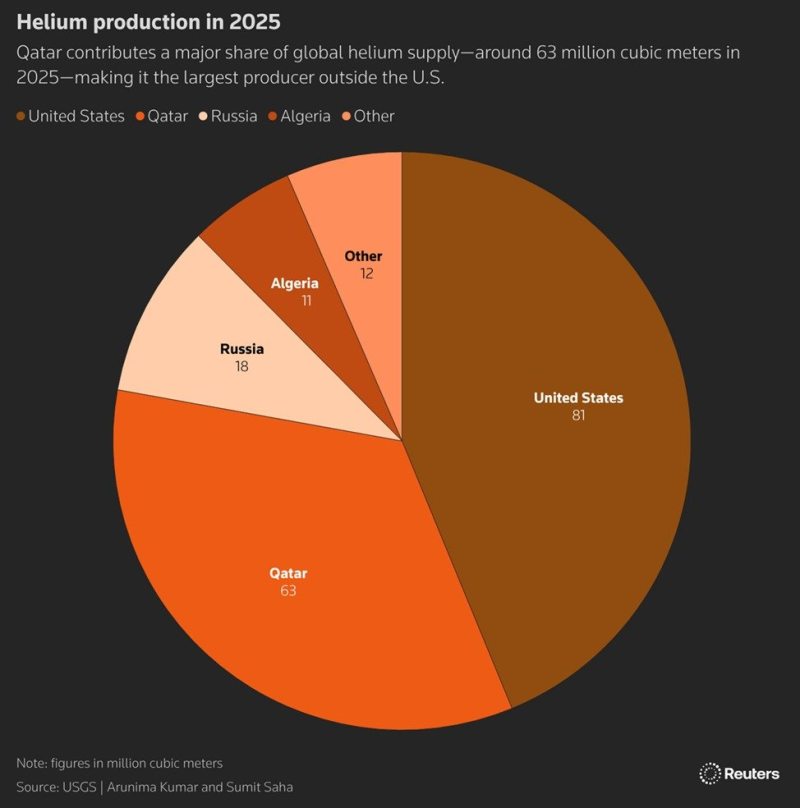
Helium production is concentrated in just a few countries. The US leads with around 81 million cubic meters annually, followed by Qatar at 63 million, Russia at 18 million, and Algeria at 11 million. All other producers combined add roughly 12 million cubic meters. That tight concentration means one facility going dark can shake the entire market. Energy markets have shown similar vulnerability to geopolitical shock, as explored in Brent Oil Calendar Spread Hits Record $25 Backwardation in March 2026.
What makes helium especially vulnerable is its storage problem. The gas slowly escapes any containment and typically needs to reach end users within about 45 days. There is virtually no strategic buffer to absorb shocks. Market data indicates helium prices have already doubled since the Iran conflict began. For context on how energy infrastructure disruptions cascade into commodity markets, see WTI Crude Oil Spikes to $110-$120 as Strait of Hormuz Closes, Brent Curve Signals Drop to $70.
If the disruption stretches 60 to 90 days, analysts expect prices could climb another 25% to 50%, potentially breaching $2,000 per thousand cubic feet. That would be more than four times the levels seen earlier in 2026. The situation is a sharp reminder that industrial gas markets tied to natural gas infrastructure carry real geopolitical risk.
 Eseandre Mordi