Victoria Bazir

Data centers that run artificial intelligence consume between 400 and 500 TWh of electricity currently. According to BloombergNEF data that Shay Boloor cited, this usage will likely reach between 1 500 and 2 000 TWh by the year 2034. By using artificial intelligence more frequently and operating large scale computers that require high amounts of power, companies are increasing total energy requirements.
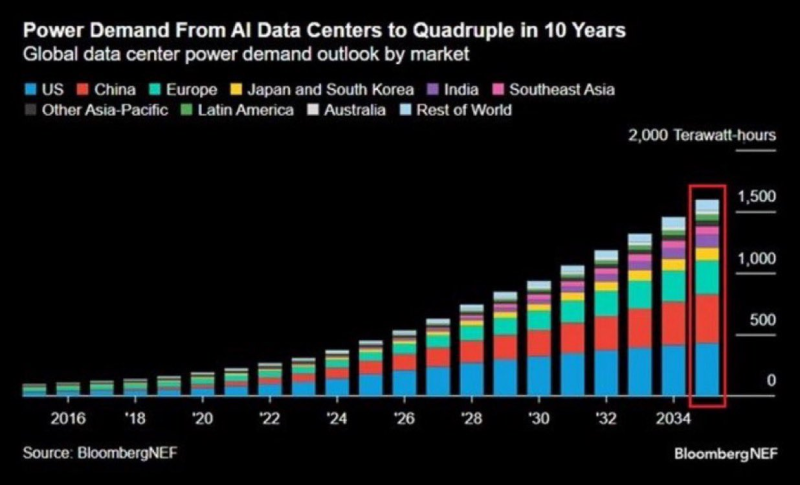
In the United States, China besides Europe, the need for electricity will expand more quickly than in other regions. It is expected that this rate of growth will rise further after 2026.
To provide enough electricity for this increase, different parts of the energy industry fulfill specific functions:
- For battery storage (TSLA, EOSE), the function is to maintain steady power when AI inference tasks are at their highest levels.
- By using nuclear power (OKLO, SMR, BWXT, CEG), providers maintain a continuous and reliable minimum supply of electricity.
- With grid and infrastructure improvements (VST, GEV, VRT), technicians increase the capacity for transmission and the ability to lower equipment temperatures.
- Natural gas (VG, NEXT) is useful because it keeps the power supply constant when renewable sources are not producing energy.
- Renewables (FSLR, BE, NEE) are present to ensure that the cost of producing each additional unit of energy remains low.
As investors put money into the physical facilities for artificial intelligence, the limited supply of energy is a primary factor that restricts growth. Due to those limits, companies are changing how they invest in the production, storage and distribution of power.
And the result is that artificial intelligence may cause the largest increase in the requirement for electricity that has occurred in many decades. When global data center use reaches nearly 2 000 TWh, workers must build new energy facilities quickly across the world.
 Victoria Bazir