Artem Voloskovets
Something significant just happened on Samsung's monthly chart — and it's the kind of move that only comes around once a generation. After holding firm for over two decades, a critical resistance neckline finally gave way, flipping from ceiling to floor and signaling a structural regime change that long-term traders have been watching for years.
A 25-Year Ceiling Becomes the New Floor
Samsung's price action has entered a full breakout phase. The neckline that defined the stock's upper boundary since the early 2000s has been convincingly cleared. What makes this particularly compelling isn't just the break itself — it's what came after. Rather than pulling back sharply, price has since used that former resistance zone as support, which is exactly the behavior technicians look for to confirm a structural shift rather than a false move.
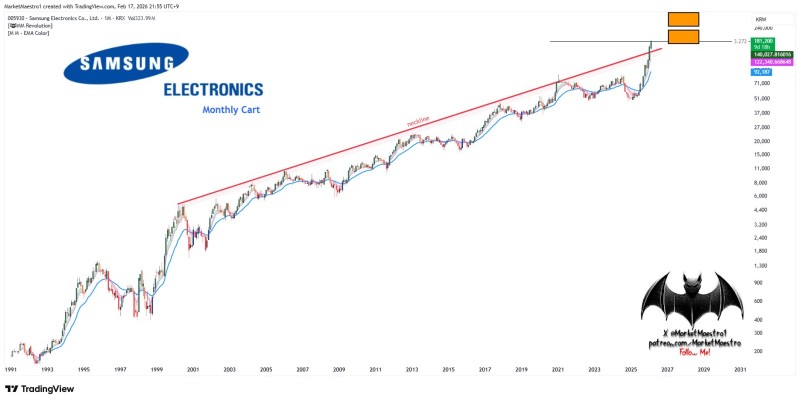
The monthly chart shows price sitting above its long-term moving average, posting higher highs and higher lows, and riding within an upward channel that's been in place for decades. The slope of that channel, however, is now accelerating — which typically signals the transition from slow accumulation into active price expansion.
Fundamentals Backing the Technical Story
The chart doesn't exist in isolation. Samsung's underlying business is building in the right direction to support this breakout. Samsung's Texas fab nears $16.5B AI chip production, placing the company squarely inside one of the most capital-intensive and strategically important sectors in global tech. Separately, Samsung 005930KS builds in-house GPU for future Exynos chips points to deeper vertical integration — a move that could meaningfully expand margins over time.
Both developments align with what the chart is projecting: a continuation scenario, not exhaustion. There's no immediate rejection signal following the breakout, and the expansion phase remains active as long as price holds above the former neckline.
Multi-decade resistance breaks are rare. When they happen — and when the fundamentals are moving in the same direction — they tend to define the next leg of a long-term trend, not just a short-term pop. For Samsung, that moment appears to be now.
 Artem Voloskovets