Usman Salis

Intel stock has pushed out of a prolonged consolidation phase, with price finally breaking above a tightly defined range that held for nearly three months. The move highlights a shift from compression to expansion, as strength that built beneath the surface is now reflected in price action.
The INTC Range That Held Price in Place
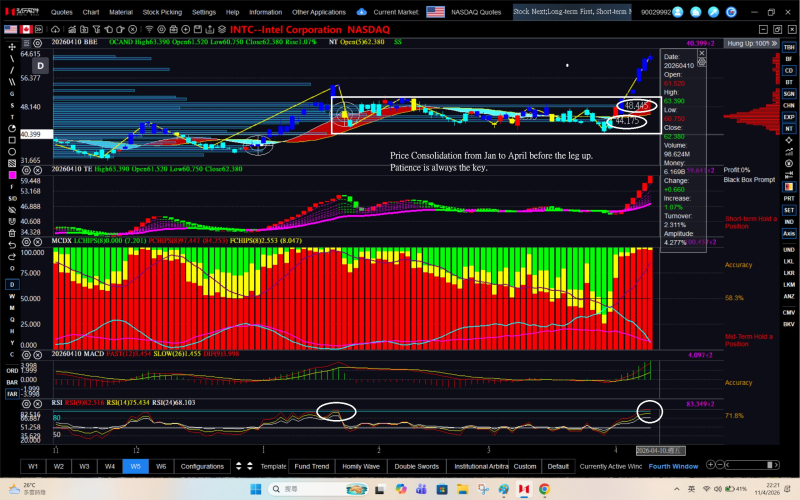
The weekly chart shows INTC trading within a clearly marked horizontal structure from January through early April. This range kept price contained roughly between the mid-$40s and upper-$40s, with repeated tests of both support and resistance.
As Danny Cheng noted, it took nearly three months of consolidation before the breakout occurred. The structure reflects a classic compression phase, where price stabilizes before a directional move emerges.
Momentum Signals That Led the INTC Move
The chart emphasizes circled points on the momentum bars, which acted as reliable buy signals ahead of the current surge. These signals appeared while price was still within the range - suggesting strengthening momentum before the breakout became visible in price action.
This pattern - momentum turning positive during consolidation - often precedes expansion phases. It indicates that buyers are building positions even as price appears stagnant. INTC stock primed for breakout after months of sideways action captured this setup as it was developing, showing how the consolidation structure was already telegraphing the potential for an upside resolution before price confirmed it.
From INTC Sideways Action to Expansion
The breakout above the upper boundary of the range signals a transition into a new phase. Price has now moved beyond the zone that capped it for months, shifting the structure toward continuation.
The setup is defined by a consistent sequence of events:
- The consolidation lasted nearly three months within the defined box
- The breakout occurred after multiple tests of the upper boundary
- Momentum signals preceded the upward move rather than confirming it after the fact
Intel stock surges amid breakout conditions shows how similar breakout setups in INTC have translated into sustained moves when the underlying conditions aligned - reinforcing that the current setup is not the first time this pattern has produced a meaningful directional shift. INTC tests and clears resistance levels adds context on how prior resistance zones have behaved once cleared, showing what follow-through typically looks like after Intel breaks a level that held for an extended period.
 Usman Salis