Editorial staff
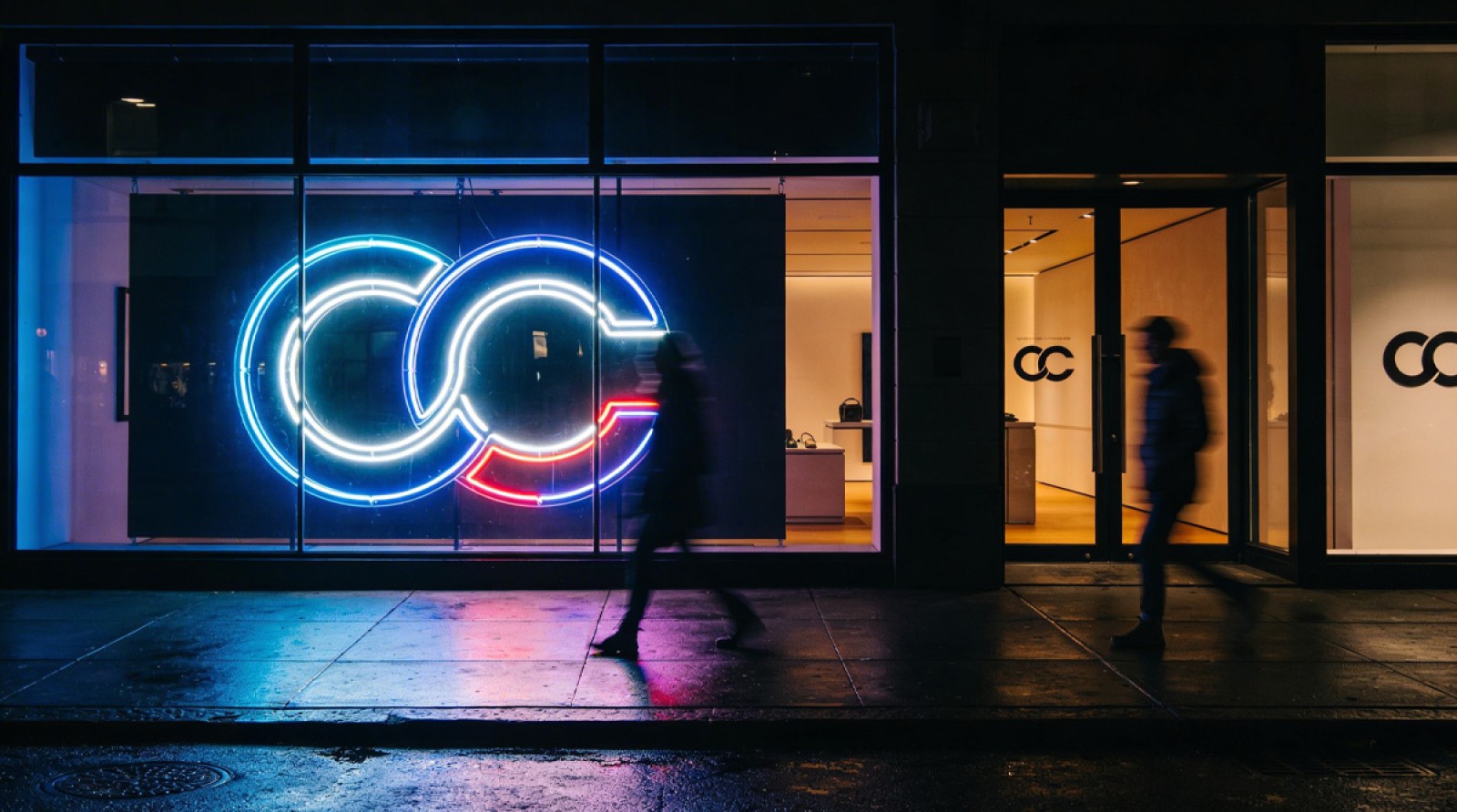
- That's not aesthetics for the sake of aesthetics. It's a strategy.
- The Economics Behind the Physical Pivot (and Why They Actually Make Sense)
- First Impressions Happen Before the Door Opens
- The Sign That Pays for Itself in Social Media Content
- What Actually Makes a Neon Sign Worth the Investment
- Your Logo in Neon Sign Is Not Vanity, It's Brand Infrastructure
- What the Brands Getting This Right Actually Have in Common
- Where This Goes From Here
That's not aesthetics for the sake of aesthetics. It's a strategy.
Numbers back this up. Opening a single new store lifts a brand's online sales by 6.9% in that trade area; for DTC brands specifically, that figure doubles. Bombas opened its first three owned retail stores in the fall of 2025, landing in NYC, Boca Raton, and Austin.
CEO Jason LaRose pointed to one stat in particular: 65% of consumers still buy socks in person. That behavior isn't going away. Warby Parker and Glossier made the same pivot years earlier and never looked back.
What unites nearly every DTC brand that successfully makes this leap? They treat the physical store as a brand experience, not a warehouse with a door. And that experience begins at the sign.
Custom neon signs aren't décor. They're the first five seconds of your brand story told in light.
The Economics Behind the Physical Pivot (and Why They Actually Make Sense)
DTC brands didn't fall in love with physical retail. They got priced out of ignoring it.
Digital advertising costs have climbed steadily for several years. iOS privacy changes, increased platform competition, and post-pandemic market saturation all pushed CAC higher. The Barcode Group noted in early 2026 that acquisition costs are "rising every minute," forcing brands toward models that mix digital reach with physical discovery.
Physical stores solve this in a counterintuitive way. They generate foot traffic you didn't pay for per click. They compress the purchase funnel too; customers who can touch the product, experience the brand, and talk to a human convert at significantly higher rates than online shoppers.
Warby Parker understood this early. Today, more than half its revenue comes from its stores. Allbirds runs around 60 locations. Glossier and ThirdLove followed the same logic. These aren't brands that failed online. They outgrew it.
The strategic case is straightforward: physical presence amplifies digital performance. The real question is how to make the most of the brand experience once someone walks through the door, and that's where signage becomes more consequential than most brand playbooks acknowledge.
First Impressions Happen Before the Door Opens
Walk past any retail strip and notice where your eyes land. Not the window display. Not the product. The light. Distinctive illumination captures peripheral vision first, meaning your branding is working before the customer has consciously decided to pay attention.
This matters in real numbers. Eighty percent of stores using custom neon signage reported a 15–40% increase in foot traffic and sales, per a Retail Lighting Association survey. Neon-lit environments also score 42% higher on "instagrammability" per Shopify's 2024 data, and warm, distinctive lighting increases customer dwell time by roughly 30%.
A DTC apparel brand case study from 2025 makes this concrete. After installing a vibrant neon sign in their flagship LA store, after-hours foot traffic jumped 30%. In-store sales climbed 12%. Customers cited the sign directly as the reason they stopped. Not the window display. Not a promotion. The sign.
There's also brand recognition research worth knowing here. Loyola University Maryland found that 80% of consumers associate a brand with its dominant color. A custom neon sign rendered in your exact brand palette isn't just attractive; it's doing identity work at a subconscious level every hour it's lit.
Physical retail is unforgiving. You don't get a second chance when someone walks by at 7 pm.
The Sign That Pays for Itself in Social Media Content
Here's what turns a visual investment into a marketing engine. Every customer who photographs your glowing sign is creating brand content you didn't commission, art-direct, or pay for. That's not a side benefit. That's the point.
A 2025 survey of 1,200 retail and DTC brand owners found that 71% of Gen Z and Millennial shoppers are more likely to share a photo of a storefront with a neon sign. A Tokyo cocktail bar saw 53% more social media tags after installing animated neon signage, alongside a 22% revenue bump.
DTC brands already understand this better than most. They were built on the premise that owned and earned media outlasted paid media over time. A custom neon sign in your retail space is a permanent content asset.
It appears in every customer photo, every store walkthrough video, every influencer haul filmed on location. Compare the one-time cost of a quality sign to the cumulative user-generated content it generates over a decade. The math is hard to argue with.
What Actually Makes a Neon Sign Worth the Investment
Not all signs are equal, and this is where working with a credible LED neon sign company matters more than most brand teams realize.
Modern LED neon (sometimes called flexible neon or neon flex) has largely replaced glass neon tubes as the standard for commercial retail.
The practical reasons are significant. LED neon has a 10-year operational lifespan, compared with 2–3 years for glass neon. It's IP65 waterproof for outdoor use. And it runs at a fraction of the energy cost.
For a DTC brand calculating overhead on its first physical location, those aren't minor details; they're the difference between a sign that needs quarterly maintenance and one that quietly does its job for a decade.
Brightness matters too, and it's worth understanding properly. Commercial-grade LED neon signs can reach 5,000+ nits, making them visible in direct sunlight. That's not just useful for Instagram shots. It matters when your storefront faces a busy street with afternoon sun, as most storefronts do.
Watch out for quality variation. Some providers use acrylic backing that yellows over time. Others cut corners on color accuracy, so your sign won't match your brand palette precisely.
Ask about backboard material, UV resistance, and whether the manufacturer's design team can match your exact hex codes before committing. The sign will outlast most of your seasonal campaigns. Get it right once.
Your Logo in Neon Sign Is Not Vanity, It's Brand Infrastructure
There's a reason the fastest-growing DTC brands entering physical retail invest in custom logo neon signs as a near-universal first step. A logo rendered in illuminated form occupies a specific psychological space: it signals permanence, investment, and confidence.
When Warby Parker opened its first stores, the cohesive visual identity said something important. Fonts, colors, lighting, and fixtures together communicated that this wasn't a pop-up testing the waters. Glossier's showrooms sent the same message.
The neon sign doesn't need to shout to work. A well-placed logo sign in brand colors, lit against a complementary wall, does something quiet but pivotal; it tells the customer they've arrived somewhere intentional.
Boutique retail locations that install custom logo neon report 15–25% increases in walk-in traffic, with a typical ROI payback period of 4-8 months. For a DTC brand spending tens of thousands on a new store buildout, a sign that converts passive foot traffic into actual entries and turns those entries into social posts earns its place in the budget immediately.
Physical retail rewards clarity. Your logo in neon is the clearest thing in the room.
What the Brands Getting This Right Actually Have in Common
The DTC brands executing physical retail with conviction share one consistent trait: they treat the store as the brand's fullest expression, not just a sales channel.
Warby Parker's stores are modeled on libraries. Books on shelves, warm light, a reading-room atmosphere. The brand positions itself as considered and intelligent, and the space says so without a word of advertising copy.
Glossier built a beauty lab because its community is curious and hands-on. Casper turned sleep testing into an interactive event. Physical space is doing brand argument work, without a single ad.
Custom neon signs participate in this when chosen deliberately. A sign displaying your brand's core conviction, not your tagline but your actual belief, creates an emotional beat in the store that lingers after the purchase. It's the difference between a space that feels designed and one that feels lived-in, real, and worth returning to.
That's the bar worth clearing. And it doesn't require a Glossier-level budget.
Where This Goes From Here
The physical pivot isn't slowing down. Digital acquisition costs keep climbing. Retail vacancies remain elevated; over 7,000 store closures in 2024 left significant available space at reduced lease rates. DTC brands now have both the incentive and the genuine opportunity to establish a physical presence faster than any previous generation of direct-to-consumer retailers.
What separates brands that build lasting locations from those treating physical retail as an expensive experiment? Intentionality in brand expression.
Custom neon signs are among the most accessible and high-impact ways to express that intentionality. They translate digital identity into physical space. They activate the UGC cycle without a budget line item. And they make the brand unmistakably present in a space that might otherwise feel like any other store.
Start there. Get the sign right. Then build the rest around what it says about you.
 Editorial staff