Victoria Bazir

But those figures alone do not explain why a company that spent years trading as one of corporate America's safest technology bets suddenly lost nearly a fifth of its value in a single session. The reaction exposed a deeper uncertainty surrounding professional services in the AI era.
A Business Built on Complexity
Large consulting firms grew alongside the expansion of corporate technology. Cloud infrastructure, cybersecurity requirements, enterprise software, regulatory frameworks, data platforms, and digital operations created a constant stream of specialized work. Few organizations could build every capability internally, so expertise became a scalable business.
Accenture turned that demand into one of the most successful growth stories of the past decade.
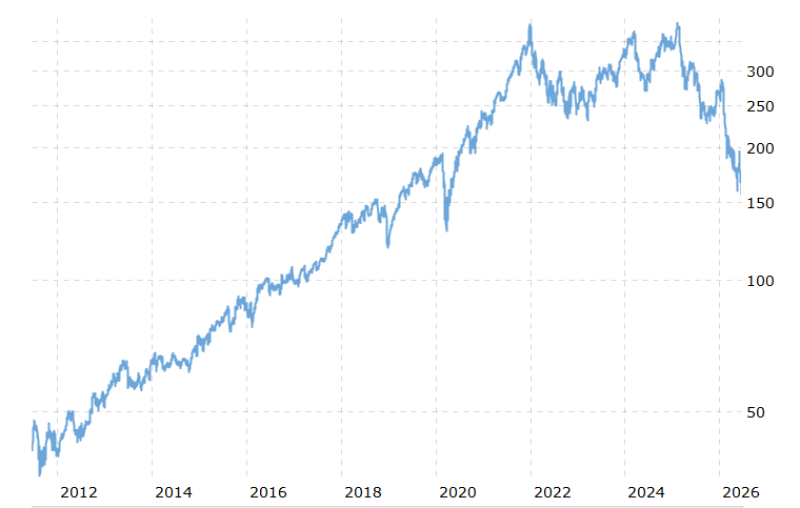
The stock climbed from roughly $30 in 2011 to more than $330 at its peak. The rise mirrors a period when businesses consistently spent more on technology and increasingly relied on external specialists to manage it.
The assumption behind that trend was simple: as systems become more sophisticated, demand for expertise grows with them. Until recently, that assumption was rarely challenged.
Productivity Changes the Economics
Previous technology waves added new layers of complexity. AI behaves differently. The technology is being deployed to reduce the amount of work required to reach a result. Research, documentation, coding, reporting, analysis, and process design can now be completed faster and by smaller teams.
The immediate effect is higher productivity. The secondary effect is less obvious. When the same outcome requires fewer people and fewer hours, the value chain surrounding that work begins to compress.
For service providers, productivity is not automatically equivalent to growth. In some cases, it can become the opposite.
The Question Behind Every AI Project
Most discussions around AI focus on adoption. A more useful question is whether the technology creates more demand than it eliminates. The answer varies by industry. Some markets expand because AI introduces entirely new requirements. Others become more efficient without generating enough new work to offset the productivity gains.
That distinction is becoming increasingly important for consulting. Many organizations still need help selecting models, restructuring workflows, integrating systems, and governing AI deployments. At the same time, the tools being implemented are steadily reducing the effort required to perform many knowledge-based tasks. The two forces are moving in opposite directions.
Why Security Keeps Attracting Capital
One detail often overlooked in the Accenture story is where the company continues to invest. Cybersecurity remains one of the few segments where technological progress consistently generates additional work rather than removing it.
Every new AI deployment expands the attack surface. More automation creates more dependencies. Larger data environments increase governance requirements. Regulation rarely becomes simpler.
This helps explain why security-related acquisitions continue attracting capital even as other areas of consulting face growing questions about future demand.
A Different Market Signal
The stock chart tells two stories. The first is the expansion of digital transformation between 2011 and 2021. The second begins several years later. The market is no longer evaluating consulting firms solely on their ability to participate in AI spending. It is also evaluating whether AI changes the economics of consulting itself.
Those are not the same thing. A company can benefit from AI adoption while simultaneously facing pressure from the productivity gains AI creates. That tension sits at the center of the current debate.
Beyond Accenture
The significance of the selloff extends beyond a single company. For more than a decade, technology complexity expanded faster than organizations could absorb it. External expertise filled the gap.
AI introduces a different possibility. For the first time in years, some forms of expertise are becoming easier to access, easier to replicate, and easier to distribute through software. That does not eliminate the need for specialists. It changes where scarcity exists.
The firms that built their businesses around scarce knowledge now face a market trying to determine how scarce that knowledge remains. Accenture's record decline may ultimately be remembered less as an earnings event than as one of the first moments when that question moved from theory into pricing.
 Victoria Bazir