Artem Voloskovets
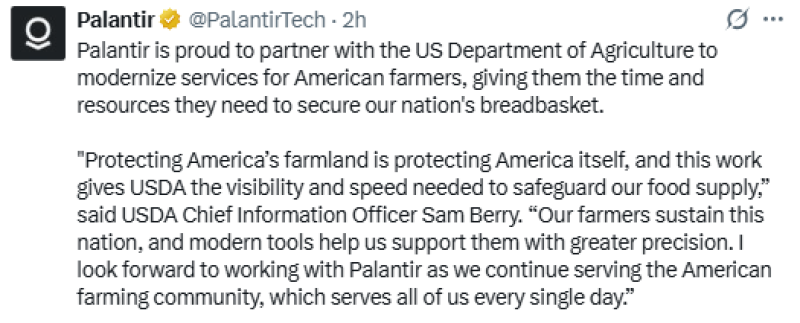
As reported in a release from Business Wire, the U.S - department of Agriculture (USDA) & Palantir Technologies have established a contract for $300 million. To achieve the goals of this agreement, the parties intend to update the methods for providing services to farmers and to increase the safety of agriculture in the United States.
By using this partnership, the USDA intends to support the National Farm Security Action Plan and make its programs more efficient. It is a priority for the department to make farms more secure because they are a part of national security. For those reasons, the USDA seeks to provide services to farmers at a faster pace.
Why Palantir
When selecting a partner, the USDA chose Palantir because the company already works within its systems. On this basis the company can combine data from many different environments that are currently separate. In its current role, the company operates the Landmark platform. By using this platform, the USDA can change its old systems into a single digital structure.
With this software, staff can analyze data immediately, find risks and coordinate how they work - those functions are necessary when the department manages large programs or makes decisions. If risks like fraud or weaknesses in the supply chain exist, this technology helps to find them.
Modernizing farmer services
To improve services for farmers, Palantir will provide tools that make operations simpler - those tools are intended to lower the amount of work for staff and make it easier for farmers to get help. Due to the changes, farmers can receive payments more quickly and see information about agricultural risks more clearly.
In this initiative, the “One Farmer, One File” program is a primary part - it uses digital tools so that there is less paper for people to fill out. As a result users can access services from different locations. And when farmers need to enroll in programs or recover after a disaster, the processes are faster.
Strategic impact
To expand on earlier work, this effort follows previous uses of the technology. For a recent assistance program, the platform allowed people to sign up online. Because the system was fast, the USDA sent billions of dollars in help in a few days.
But the partnership also has a broader purpose - for the USDA to protect farmland and make supply chains strong, it must see the risks that affect food production. There is a general trend toward an integrated system that relies on data. In this system technology is a tool to make work efficient and to monitor the agricultural sector.
 Artem Voloskovets