Marina Lyubimova

Investors are borrowing more than ever to bet on stocks. U.S. margin debt hit a record $1.28 trillion in January 2026, up about 36.5% from a year earlier, continuing one of the longest streaks of rising leverage in recent memory. For anyone watching equity markets, that number is hard to ignore.
Margin Debt Rises for 9 Consecutive Months as Investor Appetite Grows
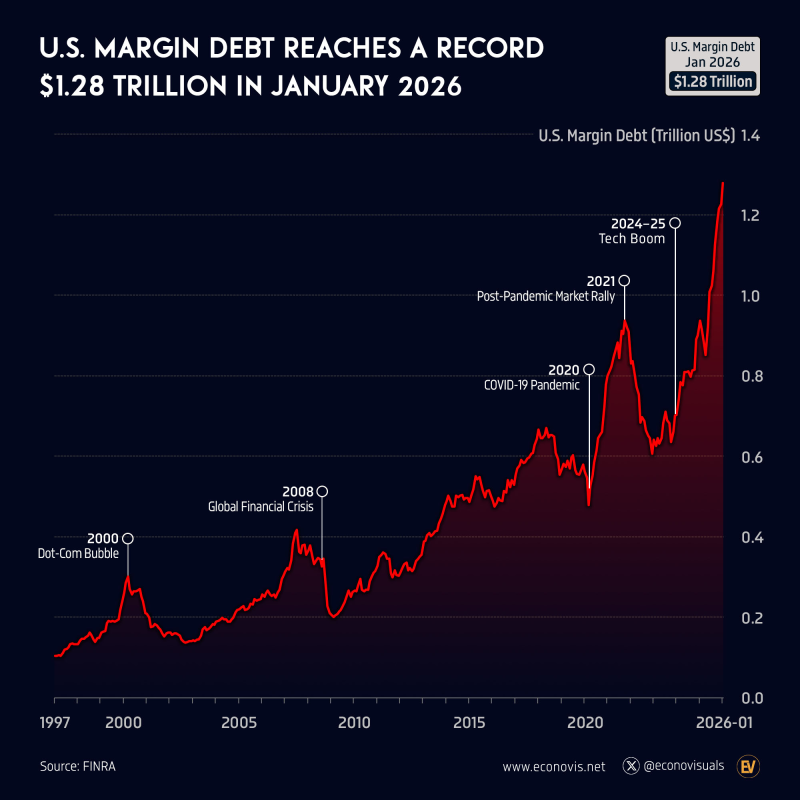
Margin debt is the total amount investors borrow from brokers to buy securities, using their existing portfolios as collateral. When markets are rising, this kind of leverage amplifies gains. But when sentiment flips, it can work just as fast in the other direction. Balances have now climbed for nine straight months, extending a trend that started well before the January reading. Margin Debt Surge Signals Market Warning — recent analysis shows that debt rose more than 42% in just seven months, a pace that historically tends to precede weaker market performance within a year.
Heavy borrowing magnifies equity gains while simultaneously increasing downside risk should price momentum falter.
Looking back at prior cycles, this kind of buildup is familiar. Margin debt peaked during the dot-com boom, again ahead of the 2008 financial crisis, and once more during the 2021 post-pandemic rally. Each time, elevated leverage preceded a sharp correction. That doesn't mean a crash is imminent, but it does mean the market is carrying more risk than it would at lower debt levels.
Why $1.28 Trillion in Leverage Is a Risk Signal Investors Shouldn't Ignore
The math here is straightforward and a little uncomfortable. When portfolios are leveraged, even a modest price decline can trigger margin calls, forcing investors to sell positions quickly. Those forced sales can push prices down further, creating a feedback loop that moves fast. ETF Flows Shift Toward Large Cap as Defensive Rotation Builds — some institutional money is already rotating into more defensive positions, a signal worth watching alongside the leverage data.
Both retail and institutional investors have contributed to the current buildup. Strong equity performance over the past year has encouraged more borrowing, which in turn has supported higher prices. That circular dynamic works well until it doesn't. As of early 2026, the combination of record margin debt, elevated valuations, and shifting positioning makes this an important moment to think about downside risk. For practical guidance on protecting a portfolio in this environment, Stock Market Safety Net: Why Every Investor Needs an Emergency Fund is worth reading before conditions change.
 Marina Lyubimova