Marina Lyubimova

The U.S. labor market is sending mixed signals in early 2026. Monthly layoff numbers eased in February, but the cumulative damage from January keeps the two-month total in historically uncomfortable territory. For companies and workers alike, the picture is one of cautious contraction rather than outright crisis - though the gap between this year and recent calmer periods is hard to ignore.
156,742 Cuts in 2 Months: Where Things Stand
U.S. layoff announcements stayed elevated in early 2026 even as February showed signs of cooling. Employers announced 156,742 job cuts in the first two months of the year, placing 2026 as the fifth-highest January-to-February total since 2009. For context, that figure sits below the 221,812 cuts recorded in the same period of 2025 and the crisis-era 428,099 in 2009, but well above the quieter stretches of the mid-2010s. As previously covered on TheTradable, sharp swings in announced cuts can quickly reshape recession risk narratives and broader market expectations.
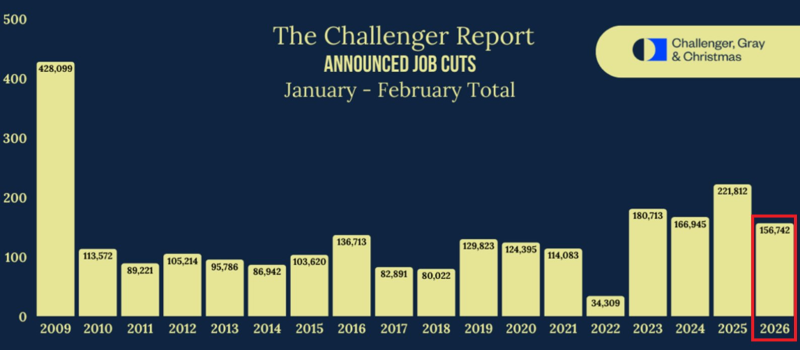
February alone accounted for 48,307 of those cuts - down 55% from January's elevated pace. That monthly pullback is meaningful, but it does not change the year-to-date picture much. The total still lands above typical pre-pandemic ranges, and a single quieter month rarely signals a sustained reversal.
Tech Leads Cuts as AI Gets 8% of the Blame
Technology is leading every other sector with 33,330 cuts year to date, up 51% year over year. One of the more notable data points in the breakdown is how explicitly AI is being cited: 12,304 job cut announcements so far in 2026 referenced AI as a contributing factor, representing roughly 8% of all layoff plans. That means the vast majority of reductions are still tied to other drivers, from cost restructuring to slowing revenue. Recent examples include Amazon cutting nearly 40% of 4,700 engineering roles, and separately, reports of AMZN stock sliding on plans for 30,000 additional job cuts.
Most reductions are being attributed to factors other than AI - but the trend is worth watching as automation pressures build.
Hiring plans are telling their own story. Planned hiring is down 56% year to date compared to 2025, with just 18,061 new positions announced versus 40,669 over the same stretch last year. The combination of elevated layoffs and historically weak hiring intentions reflects a corporate mindset still oriented toward trimming rather than building - a backdrop that tends to weigh on consumer confidence and keeps markets watching every jobs print closely.
 Marina Lyubimova