Marina Lyubimova

The SPDR S&P 500 ETF Trust (SPY) is running into a stubborn ceiling. Over the past two weeks, the 8-day exponential moving average has acted as a consistent lid, turning back every attempt at recovery. Price is currently hovering near $668, and repeated failures at this level are starting to tip the short-term momentum decisively to the downside.
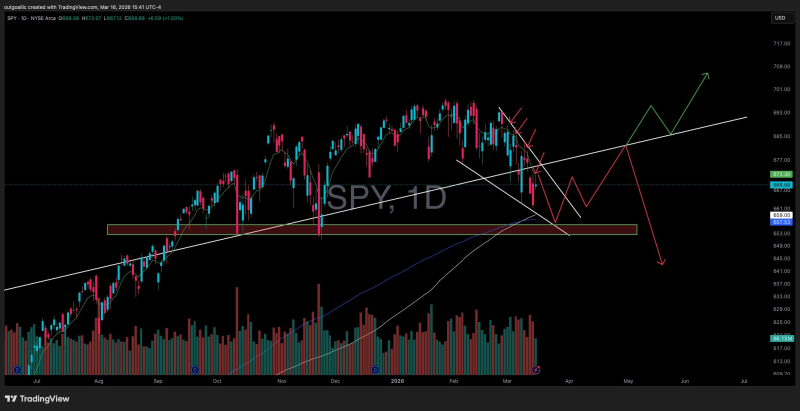
Multiple rejection points cluster at the declining 8-day EMA, keeping the pressure on. If that pattern holds, the most likely next stop is the 200-day moving average sitting near $657 - a level that also lines up with a key support zone between $653 and $657. This confluence was previously flagged in SPY Drops to $666-$674 Support Zone: Elliott Wave Analysis Shows Pullback Nearing End, where analysts identified the area as a potential floor during corrective moves.
The 200-day MA region carries extra weight because it also converges with a long-term rising trendline that has underpinned SPY's broader uptrend for over a year. A clean bounce from that zone could send the ETF back toward the $685 area, where the next resistance battle would play out. A similar setup played out in SPY Pullback Hits Support at $678 as Elliott Wave Structure Holds, where shallow pullbacks within the larger trend set up the next leg higher.
Despite the near-term choppiness, SPY is still trading at historically elevated levels. Internal stress is building beneath the surface - as detailed in 115+ S&P 500 Stocks Crashed 7% While SPY Trades Near Record Highs, significant damage can accumulate in individual names even when the index headline number looks fine. This kind of divergence typically signals growing fragility underneath a calm surface.
The current setup puts SPY at a technical fork. Hold the 200-day MA and the bullish trend stays intact, with $685 as the near-term upside target. Break below the $653-$657 support band and the probability of a more extended correction rises sharply. Either way, the next week of price action around this level will go a long way toward defining the market's direction heading into the next quarter.
 Marina Lyubimova