Usman Salis

The U.S. economy is showing clear signs of deceleration, with real GDP growth falling to just 0.5% annualized in Q4 2025. The latest data reflects a sharp slowdown from earlier in the year, pointing to weakening momentum across key components of economic activity.
US GDP Growth Engine Loses Strength
As Global Markets Investor noted, growth dropped from 4.4% in Q3 and 3.8% in Q2 to just 0.5% in Q4 - the weakest pace in more than two years. The deterioration is broad-based rather than isolated to a single component.
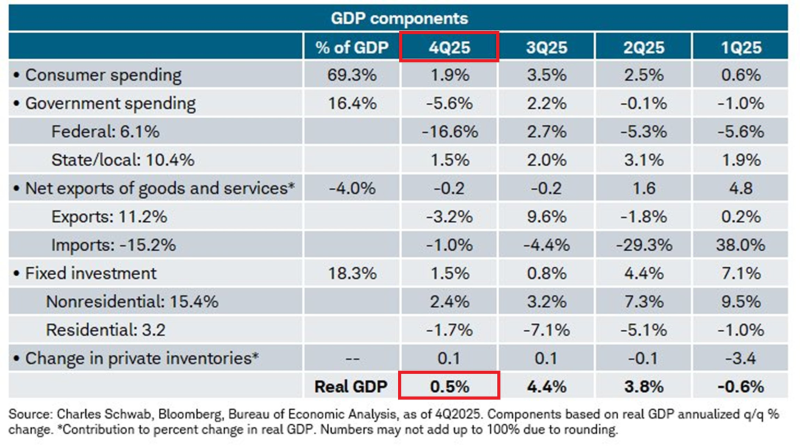
Consumer spending, which accounts for roughly 69% of GDP, slowed to 1.9% from 3.5% in the previous quarter. This deceleration is significant given the dominant role of consumption in overall economic activity.
GDP News: U.S. Faces Pressure as Consumer Spending Falls While Data Center Investments Rise captured the emerging tension between weakening consumer demand and the AI infrastructure investment cycle - a dynamic that is now showing up clearly in the Q4 breakdown.
Momentum Fades Across Key US GDP Components
Beyond consumption, other areas of the economy also showed signs of cooling. Federal spending declined by 16.6% during the quarter - largely due to the 43-day government shutdown - shaving 1.16 percentage points off Q4 GDP growth alone.
Fixed investment rose 1.5% in Q4, after 0.8% in Q3 and 4.4% in Q2. Within that, nonresidential investment grew 2.4% while residential investment remained negative at -1.7%. Net exports also stayed a drag on growth, with exports falling 3.2% and imports declining 1.0%.
$10/Barrel Rise Could Cut GDP 0.1% and Push Inflation to 2.7% adds another layer of downside risk to the picture, showing how energy price pressures could compound the GDP weakness already visible in the Q4 data.
A Weaker US GDP Trend Heading Into 2026
The broader annual picture reinforces the slowdown. For full-year 2025, the U.S. economy grew 2.1%, down from 2.8% in 2024 and 2.9% in 2023. That longer-run cooling points to a structural deceleration rather than a one-quarter anomaly.
US GDP Growth Slows to 2.1% in 2025 After 2.9% Peak Two Years Ago documents the full-year trajectory that Q4's 0.5% reading sits at the end of - showing how the annual slowdown has been building gradually before the sharp deceleration visible in the final quarter.
With momentum notably weaker than in prior years and multiple components of growth softening simultaneously, the Q4 data leaves little ambiguity: the U.S. economy is entering 2026 on less stable footing than it has stood on since the post-pandemic recovery began to mature.
 Usman Salis