Marina Lyubimova

⬤ Singapore has pulled significantly ahead of Hong Kong in economic growth over the past 16 years, according to World Bank data shared by economist Steve Hanke. Using 2008 as a baseline of 100, Singapore now sits at an index level of 152 while Hong Kong registers just 121—a 31-point gap between two cities that once competed neck-and-neck.
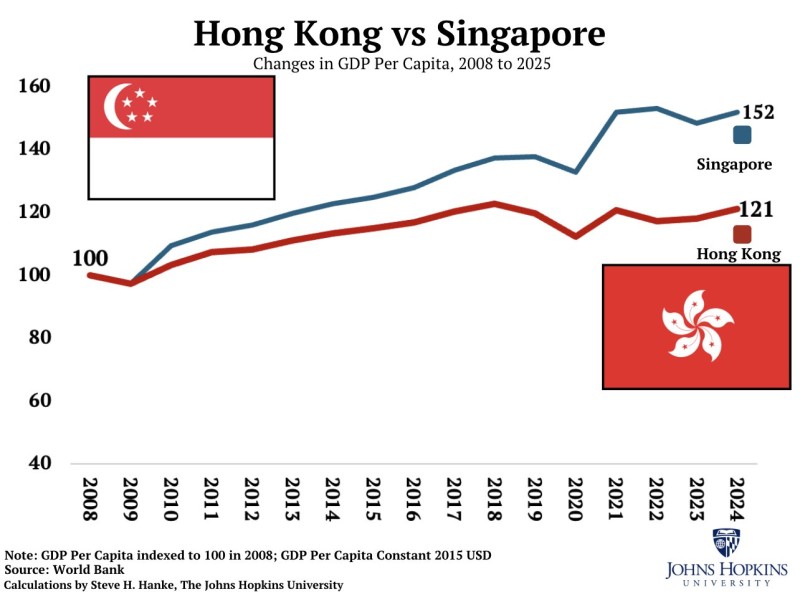
⬤ The divergence wasn't always obvious. Both financial centers tracked closely through the early 2010s, but Singapore began separating from the pack around mid-decade. By 2020, both economies took a hit—likely pandemic-related—but Singapore's recovery trajectory proved stronger. The chart tells a simple story: one hub kept climbing while the other plateaued.
⬤ Economist Steve Hanke shared the World Bank data highlighting this shift. Where Singapore maintained steady upward momentum, Hong Kong's gains came slower and more erratically. The gap widened year by year, transforming what was once a tight race into a clear lead.
Singapore's growth since 2008 has outpaced Hong Kong's.
⬤ This shift matters beyond GDP statistics. Both cities compete for the same global capital, talent, and business activity. Singapore's edge shows up in policy discussions too—from crypto hubs like Singapore and Hong Kong positioning to high-stakes meetings like Ripple Meets UK Economic Secretary in Singapore, where digital-asset policy gets hammered out. Global players increasingly cluster around winners, and the data suggests which hub currently holds that title.
⬤ Hong Kong still maintains structural advantages—its business-friendly environment and role as a financial hub keeps it relevant. But the 31-point index gap reflects more than just numbers. It captures a decade-plus of policy choices, economic resilience, and competitive positioning. Even with Trump's recent "crypto capital" push and ongoing competition among Asian hubs, Singapore's lead remains unmistakable.
 Marina Lyubimova