Artem Voloskovets

The gap between wage growth and inflation in the U.S. has narrowed to almost nothing — a renewed squeeze on consumers that few saw coming this fast. According to Heather Long's analysis, wages rose 3.5% over the past year in March, while inflation reached 3.3%, leaving almost no room for real income growth.
Earlier, wage growth clearly exceeded inflation, giving households some financial cushion. Now, the two lines have nearly met — indicating that most nominal income gains are being offset by rising prices. The visual compression between the two series reflects a shift from recovery into a period where purchasing power is no longer meaningfully improving.
Wages rose 3.5% over the past year in March — the lowest growth rate since May 2021 — while inflation moved back up to 3.3%, effectively wiping out most gains for American workers.
The Inflation-Wage Spread That Has Nearly Vanished in 2026
The chart tracking both metrics tells the story clearly. Wage growth has been steadily declining from the elevated levels seen in 2023, settling at 3.5% by early 2026. Meanwhile, inflation — after easing through parts of 2024 and 2025 — has crept back up to 3.3%. That convergence is now the defining feature of the current economic setup.
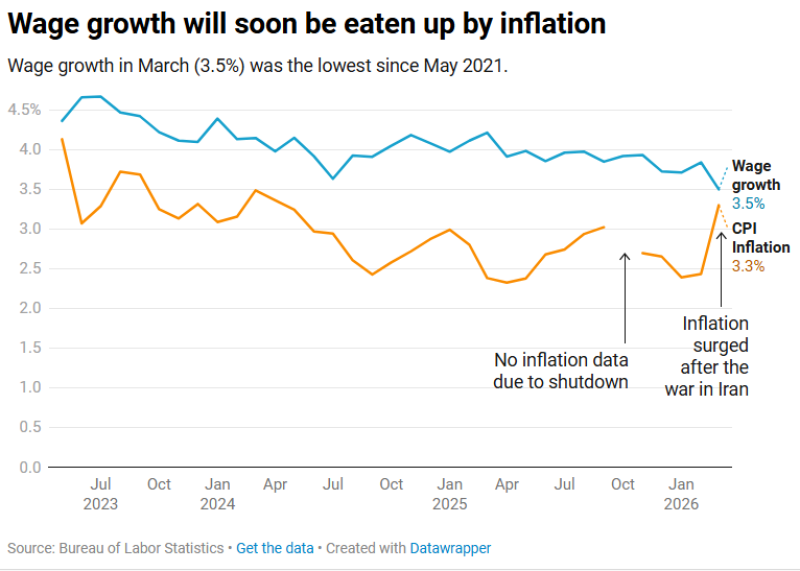
There is also a visible interruption in the inflation data due to a shutdown period, followed by a renewed climb. This reinforces that inflation's path has been anything but smooth — not a clean decline, but an uneven retreat that left households repeatedly exposed. The Germany CPI data showing core inflation stuck at 2.7% points to how widespread this dynamic has become across developed economies.
This convergence is the defining feature of the current setup. Earlier, wage growth clearly exceeded inflation, giving households some buffer. Now, the two lines have nearly met.
A Familiar Inflation Squeeze Returns to U.S. Consumers
This setup mirrors conditions seen in earlier periods when inflation effectively absorbed wage gains, leaving households with little real progress despite rising paychecks. March wage growth at 3.5% is the lowest since May 2021 — a figure that reinforces how much income momentum has slowed since the post-pandemic recovery peak.
Similar dynamics are playing out in other areas of household budgets. Data on water bills rising by 200% shows how persistent price pressures are hitting American families from multiple angles at once — not just at the supermarket, but across basic utilities and services.
When Real Wage Growth Drops to Near Zero: Key Numbers
The key takeaway is the narrowing difference between the two main indicators:
- Wage growth: 3.5% (lowest since May 2021)
- Inflation: 3.3%
- The remaining real spread: effectively minimal
This alignment is what analysts mean when they describe a wage-inflation squeeze — a situation where nominal paychecks grow on paper, but almost nothing is left over after prices take their share. Real-time tracking of this dynamic is possible through alternative measures as well: Truflation's real-time U.S. inflation index recently fell to 0.98%, though official CPI figures used for wage comparisons continue to paint a tighter picture.
With wages and inflation now nearly equal, even small changes in either direction could determine whether real wages turn negative again — reinforcing pressure on consumers in the months ahead.
With the two metrics running almost in parallel, even a modest tick upward in inflation — or a further softening of wage gains — could push real wages back into negative territory. For millions of American households, the recovery in purchasing power that seemed within reach just a year ago is now hanging by a thread.
 Artem Voloskovets