Saad Ullah

The debate over Federal Reserve monetary policy has reached a boiling point as alternative inflation metrics paint a dramatically different picture than official government reports. With real-time trackers showing inflation well below the Fed's target, critics argue policymakers are moving too slowly to adjust rates in response to cooling price pressures.
TruFlation Data Shows Inflation at 0.96% While Fed Holds Firm
The monetary policy debate intensified after fresh inflation readings continued to print below the Federal Reserve's 2% target in some trackers. As reported by @CryptosR_Us, Anthony Pompliano said every inflation reading this year has come in under 2% and argued the Fed should be cutting rates now rather than keeping policy tight.
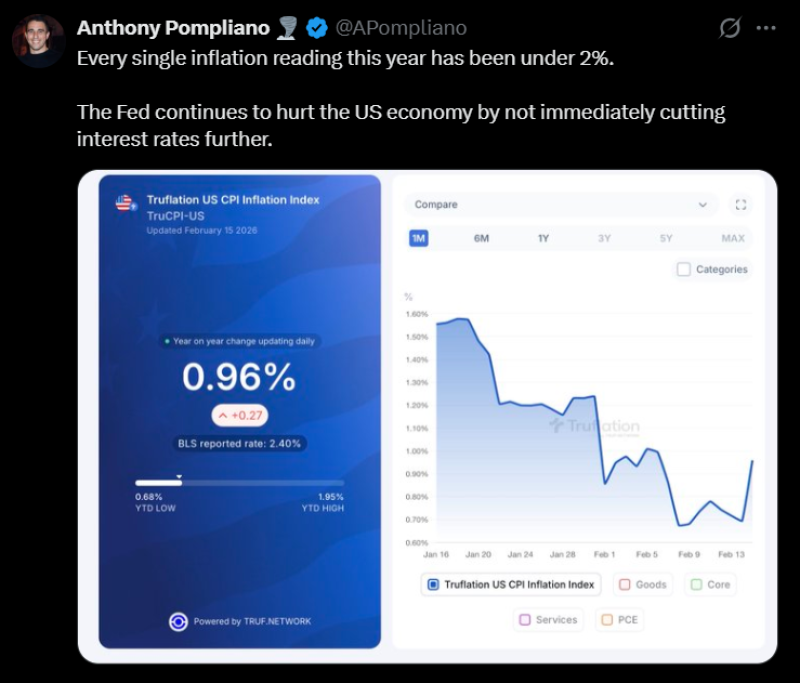
The TruFlation US CPI Inflation Index currently sits at roughly 0.96% year over year, a stark contrast to the official BLS-reported rate hovering near 2.40%. The TruFlation line chart has trended consistently lower throughout recent months, backing Pompliano's assertion that price pressures have genuinely cooled. As he put it, "every inflation reading this year has come in under 2%" — a statement that challenges the Fed's cautious stance.
Similar tracker-driven narratives have surfaced in recent coverage, with reports noting Truflation Index shows inflation below 2% and reinforcing the call for overdue rate cuts.
Why the Fed May Be Reacting Too Slowly to Disinflation Signals
The core criticism centers on timing and data lags. Commentators suggest Chair Powell and other policymakers may be responding too slowly if real-time measures are signaling faster disinflation than official releases capture. Market participants have already begun pricing in policy shifts, with coverage highlighting Fed rate cut expectations grow as markets price in faster easing.
The Impact of Alternative Inflation Trackers on Rate Cut Expectations
The widening gap between alternative inflation trackers and official prints has become a pivotal element in rate-cut discussions. These divergences directly influence expectations about when the Fed might pivot to easier policy. Recent data underscored this split, with reports showing US inflation drops to 0.72% according to TruFlation data — illustrating how different measurement approaches can reshape the macro narrative around rates and economic momentum.
As the gap persists, pressure mounts on the Federal Reserve to reconcile real-time signals with traditional data and adjust policy accordingly. Whether policymakers respond to these alternative metrics or stick with official figures will likely define the path of interest rates in the months ahead.
 Saad Ullah