Usman Salis

China's oil import structure is quietly concentrating around a single corridor — and the numbers are hard to ignore. As Econovis reported, China sourced 5.55 million barrels per day of crude oil through the Strait of Hormuz in 2025, accounting for roughly 49% of its total imports. That's not a temporary spike — it's the result of a sustained upward trend years in the making.
Nearly half of China's crude imports now pass through a single maritime corridor, with no clear sign of that changing.
The shift didn't happen overnight. Starting from lower levels in the mid-2010s, the share of Chinese crude flowing through Hormuz gradually pushed higher into the 2020s. Once it crossed the 40% mark, the momentum continued — eventually approaching the 50% threshold.
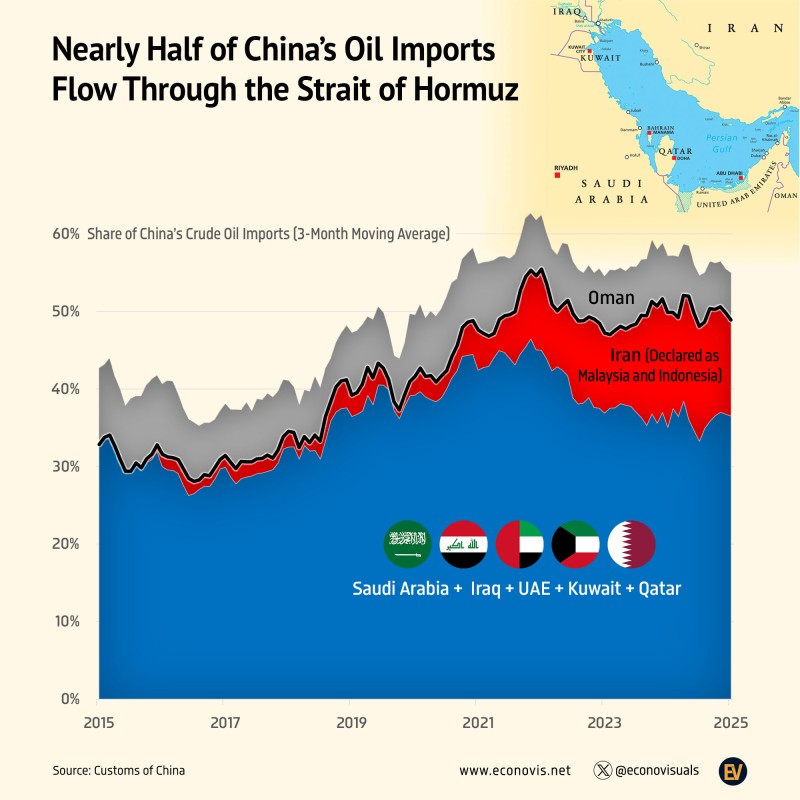
More recently, the structure has settled into a sideways range just below that level. The upper boundary near the low-50% area has been tested several times, while pullbacks have stayed shallow, leaving the overall trend firmly intact. What was once a rising share has now stabilized near historic highs.
Saudi Arabia, Iraq, UAE Lead the 3.99 mb/d Supplier Bloc
The composition of those flows tells the story clearly. Saudi Arabia leads as China's largest supplier at 1.6 million barrels per day, followed by Iraq at 1.25 mb/d, the UAE at 0.76 mb/d, and Kuwait at 0.37 mb/d. Combined, these four Gulf states alone account for 3.99 mb/d of Hormuz-linked crude.
Beyond the core four, additional volumes add further weight to the same corridor:
- Iran contributes roughly 1.55 mb/d, often reported under alternative origins including Malaysia and Indonesia
- Oman adds approximately 0.71 mb/d, also routed through the same maritime passage
This layered supplier structure is what makes the exposure so sticky — it isn't one country driving the concentration, it's the region as a whole.
The layered supplier structure means reducing Hormuz exposure isn't simply a matter of switching one partner for another.
A Structural Dependence With No Sign of Easing
The most telling feature of the data is its persistence. Despite the scale of the exposure, there's been no meaningful diversification away from Hormuz-linked flows. The share fluctuates, but consistently near historical highs — the system has stabilized at elevated levels, not rotated out of them.
This dynamic connects directly to a broader strategic picture. China Pivots Oil Strategy: 300,000 Barrel Daily Shortfall Drives Shift to Canadian Crude explores how Beijing is beginning to look for alternatives, while WTI Oil in Focus as Strait of Hormuz Hits 62,010 Bloomberg Stories in March 2026 captures just how much market attention the chokepoint is attracting. The vulnerability isn't abstract — as Oil Flows Fracture as Red Sea Risk Builds in 2024 showed, regional disruptions translate quickly into real supply fractures.
With nearly half of China's oil imports tied to a single chokepoint, the sensitivity to any disruption in the region is not a tail risk — it's a baseline condition.
With 5.55 mb/d of crude dependent on safe Hormuz passage, the structural question isn't whether the exposure exists — it's how long it can remain this concentrated before markets start pricing in the risk more aggressively.
 Usman Salis