Usman Salis
XRP is flashing a notable stress signal. On-chain data from Glassnode shows that more than 50% of the token's circulating supply is currently held at a loss, meaning the majority of XRP holders bought in at prices higher than where the asset trades today. The "Total Supply in Loss" metric has crossed the halfway mark, and analysts are watching closely to see whether this reflects a temporary shakeout or a deeper shift in market structure.
Historical Context: What the 50% Threshold Has Meant for XRP Before
This is not the first time XRP has seen such broad unrealized losses. The Glassnode chart shows comparable spikes during the 2019-2020 downturn and again during later market corrections, when the supply held at a loss surged toward the 40 billion XRP range as prices fell. As XRP Drops Below Realized Price: Over 50% of Holders Now Sitting at a Loss detailed, when the token falls beneath its average cost basis, the psychological and technical pressure on holders tends to intensify.
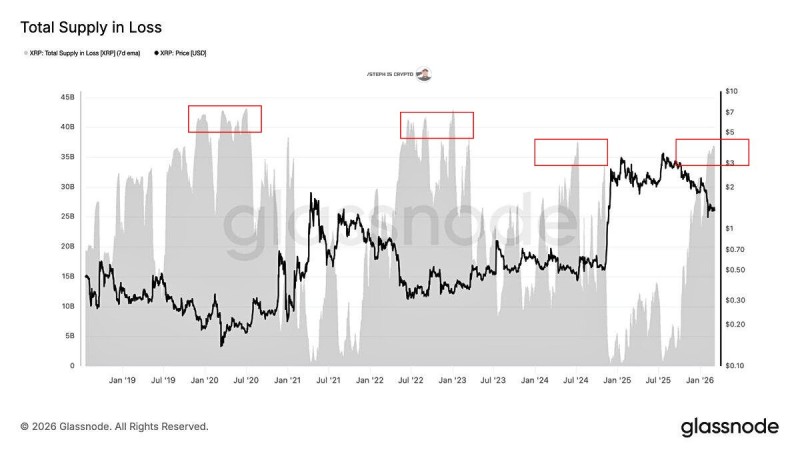
Each of those historical episodes saw the gray supply-in-loss area expand sharply before eventually contracting as prices recovered. The current reading places XRP in a comparable position, with a large share of the holder base sitting on unrealized losses and market confidence under pressure.
Weakening Sentiment: NUPL in Fear, Exchange Outflows Slowing
Broader on-chain sentiment indicators are pointing in the same direction. The Net Unrealized Profit and Loss metric has recently slipped into the "fear" zone, a development covered in depth in XRP On-Chain Sentiment Drops Into Fear as NUPL Falls Below 0.25. Meanwhile, the dip-buying momentum that had been visible in earlier sessions has begun to fade. Exchange outflow data shows fewer tokens being withdrawn from trading platforms, a trend outlined in XRP Exchange Outflows Drop From 71M to 42M as Dip-Buying Momentum Fades. Together, these signals point to a market where short-term conviction has softened.
The rise in supply held at a loss marks a critical phase in the XRP cycle. Profitability metrics and price action will continue to shape the broader outlook as the market navigates lower momentum and shifting investor behavior.
 Usman Salis