Saad Ullah
JPMorgan has published a research paper titled "Unlocking $120 Billion Value in Cross-Border Payments," and XRP made the cut. Exhibit 3 of the document puts Ripple directly alongside CLS, SWIFT, and Fnality in a comparative framework of global settlement systems, citing XRP as a bridge asset for cross-border transactions.
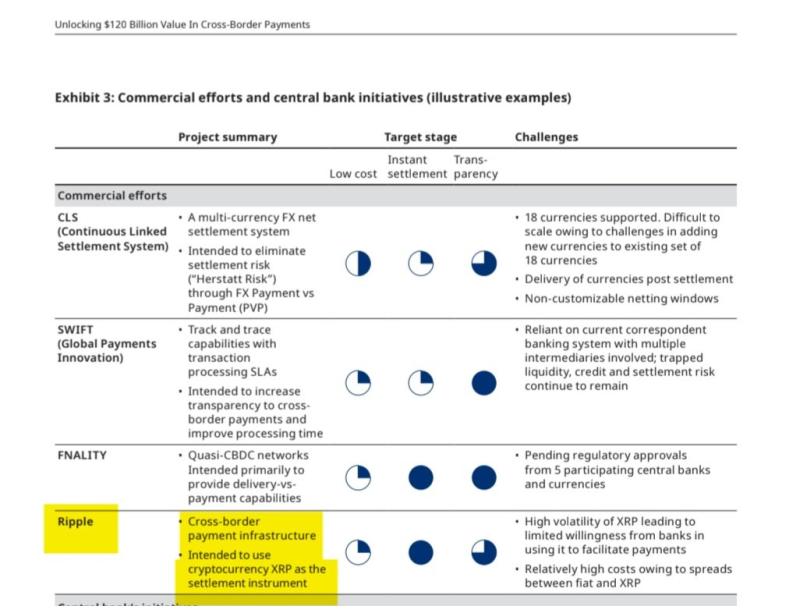
Within the comparison, Ripple is described as providing cross-border payment infrastructure designed around XRP for settlement. The chart draws a clear line between Ripple's model and traditional correspondent banking networks. This positioning has real-world backing: a Brazilian firm recently launched a $130M platform built on XRP Ledger, signaling growing institutional adoption of blockchain-based finance.
The report doesn't ignore the friction points. JPMorgan flags XRP's high volatility as a likely deterrent for banks, along with elevated transaction costs tied to fiat-to-XRP spreads. Other systems in the chart carry their own baggage - SWIFT leans on slow intermediaries, while Fnality is still awaiting regulatory clearance. Meanwhile, Securitize's $4B SPAC filing is opening new doors for XRP real-world asset growth, adding another layer to the tokenization story.
The broader takeaway from JPMorgan's analysis is that blockchain-based systems are increasingly part of serious conversations about payment efficiency, transparency, and settlement speed. Analysts are tracking this closely: three bullish signals could send XRP soaring toward $5, with XRP Ledger adoption expanding alongside tokenized asset activity.
Being named in a major financial institution's infrastructure study is not a small thing. As banks and regulators continue testing alternatives to legacy settlement models, XRP's presence in JPMorgan's framework signals that blockchain-based payment rails are moving from experiment to expectation.
 Saad Ullah