Eseandre Mordi

Retail investors are sharply reducing exposure to leveraged equity products. As The Kobeissi Letter noted, US leveraged equity ETFs have recorded roughly $50 billion in outflows over the past year - the deepest pullback on record. The data covers 2x and 3x long and short leveraged funds tied to single stocks, major indices, and the VIX. The chart reinforces that message visually, showing a dramatic collapse in the one-year rolling sum to nearly -$50 billion by 2026.
The Leveraged ETF Breakdown That Stands Apart
The long-term chart shows that leveraged ETF flows have swung between inflows and outflows for years - but prior drawdowns were materially smaller. Even during earlier periods of heavy pressure, the rolling one-year total generally stabilized well before reaching today's extreme reading.
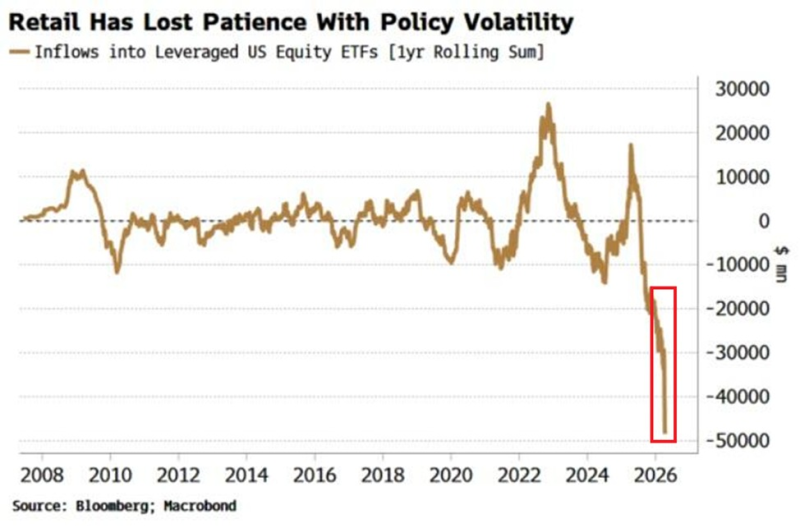
This time, the structure is far more severe. After moving higher and briefly surging into positive territory, the flow trend reversed violently and fell almost straight down. The latest leg lower broke beneath prior outflow troughs and extended toward the -$50 billion mark - exceeding peak outflows seen in 2020, 2021, and 2024 by roughly 250% to 400%.
Retail Investors Sold $54.8M in Stocks as Dip-Buying Trend Breaks Down captured the broader behavioral shift in retail positioning, showing how the retreat from leveraged products is part of a wider pattern where the dip-buying instinct that defined retail behavior in prior cycles has reversed.
A Clear Reversal in Retail Leveraged ETF Behavior
The tweet draws a striking comparison with 2022. During that bear market, leveraged US equity ETFs saw approximately $25 billion in inflows - indicating that traders were still willing to add aggressive exposure during weakness. That behavior has now flipped entirely.
Instead of buying volatility, retail investors appear to be retreating from it. The combination of record outflows and a nearly vertical drop in the chart suggests that the appetite for high-risk tactical positioning has deteriorated sharply.
SPX Volatility Spread Hits Highest Since 2008, Barchart Says provides the volatility backdrop that helps explain why retail investors are retreating - when volatility reaches extremes last seen in 2008, the amplified exposure that leveraged ETFs provide becomes a source of outsized pain rather than opportunity.
Volatility Has Changed the Retail Leveraged ETF Tone
Because these products are built for amplified exposure, their flow trends often reveal how confident or defensive retail traders have become. With both long and short leveraged funds included in the measure, the record outflow suggests broad disengagement from speculative positioning rather than a simple directional bet.
That makes this chart less about one trade and more about a wider shift in behavior. Retail Investors Didn't Get Smarter - Markets Forced Them To frames the behavioral change in its broader context - arguing that the retreat from leveraged products reflects not wisdom but exhaustion, where repeated losses have eroded the appetite for aggressive tactical positioning that characterized retail behavior throughout the post-2020 period.
The signal from the chart is straightforward: retail investors have lost patience with leveraged volatility, and the scale of the retreat has reached a historic extreme that goes well beyond anything seen in prior stress episodes.
 Eseandre Mordi