Eseandre Mordi
⬤ The WTI oil market is going through a structural shift as US reliance on Persian Gulf crude hits one of its lowest points in decades. Imports from major Gulf exporters, including Saudi Arabia, Iraq, Kuwait, the UAE, Bahrain, and Qatar, have fallen to roughly 500,000 barrels per day, close to the lowest level on record and a clear sign of a fundamentally different energy balance for the United States.
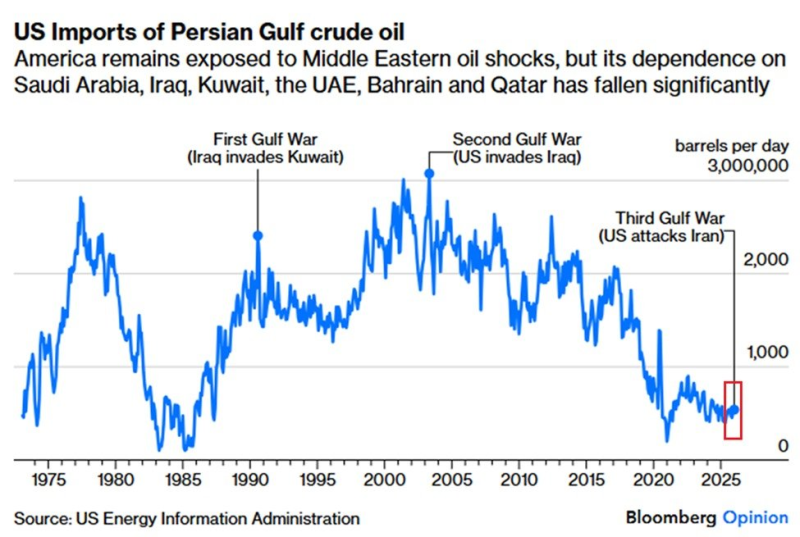
⬤ Historically, US imports from the region topped 3 million barrels per day in the early 2000s, peaking around the time of the 2003 Iraq war. Since then, volumes have dropped by roughly 2.5 million barrels per day. Even a decade ago, the US was still receiving around 2 million barrels per day from Gulf nations. Today's import levels sit only slightly above the lows hit during the 2020 pandemic shock and the 1980s oil downturn.
US crude output currently stands near 13.7 million barrels per day, close to an all-time high after surging roughly 145% since 2003.
⬤ This decline has coincided with a dramatic rise in domestic output. US crude production now sits near 13.7 million barrels per day, up roughly 145% since 2003. Advances in shale drilling and expansion across key US basins have massively increased supply, reducing the country's appetite for foreign crude and reshaping the structure of the WTI oil market within global energy flows.
⬤ The sharp pullback in Gulf imports underscores just how much the global WTI oil market has changed over the past two decades. With domestic production elevated and Middle Eastern dependence sharply lower, the US now operates with a very different energy profile compared to previous generations. These structural changes continue to reshape global oil trade flows and the broader dynamics of the WTI oil market going forward.
 Eseandre Mordi