Saad Ullah
⬤ US gas prices jumped to $3.93 per gallon, the highest reading since August 2022. The national average climbed from $2.94 just one month prior, a 34% increase that ranks as the steepest monthly rise in over three decades. US gasoline prices surge and inflation impact have already become a key concern for economists tracking household budgets and broader price dynamics.
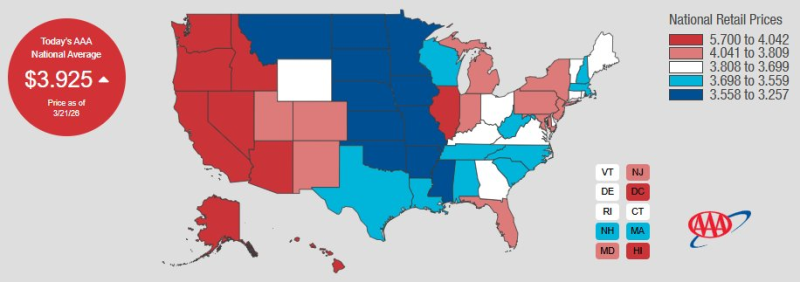
⬤ The scale of the move is hard to overstate. A $0.99 jump in a single month is not just a data point, it is a signal. Several regions are now crossing the $4 per gallon threshold, while central states are holding closer to the mid-$3 range. The breadth of the increase points to a synchronized national shift rather than localized pressure from a single market or refinery issue.
⬤ Regional gaps are still visible, with coastal states and parts of the West carrying the highest prices. But the upward trend is consistent coast to coast. This mirrors recent volatility in crude markets, where WTI oil rally and energy market momentum have accelerated sharply over a compressed timeframe, pulling retail fuel prices along with them.
⬤ The social impact is uneven. Research on gasoline prices and economic pressure trends shows that low-income households absorb fuel cost shocks at roughly three times the rate of wealthier ones. A spike of this size does not just affect pump receipts; it shifts disposable income calculations for millions of Americans and feeds directly into broader inflation readings.
 Saad Ullah