Eseandre Mordi

Most supply chain stories involve things people can see: ships stuck in ports, factories going dark, export bans making headlines. This one is different. Helium is invisible, odorless, and rarely discussed outside industrial circles. But right now it's becoming one of the more consequential pressure points in global semiconductor manufacturing.
Global Markets Investor flagged the developing situation, pointing to damage at Qatar's Ras Laffan LNG facility following an Iranian strike and the ripple effects now moving through tech supply chains.
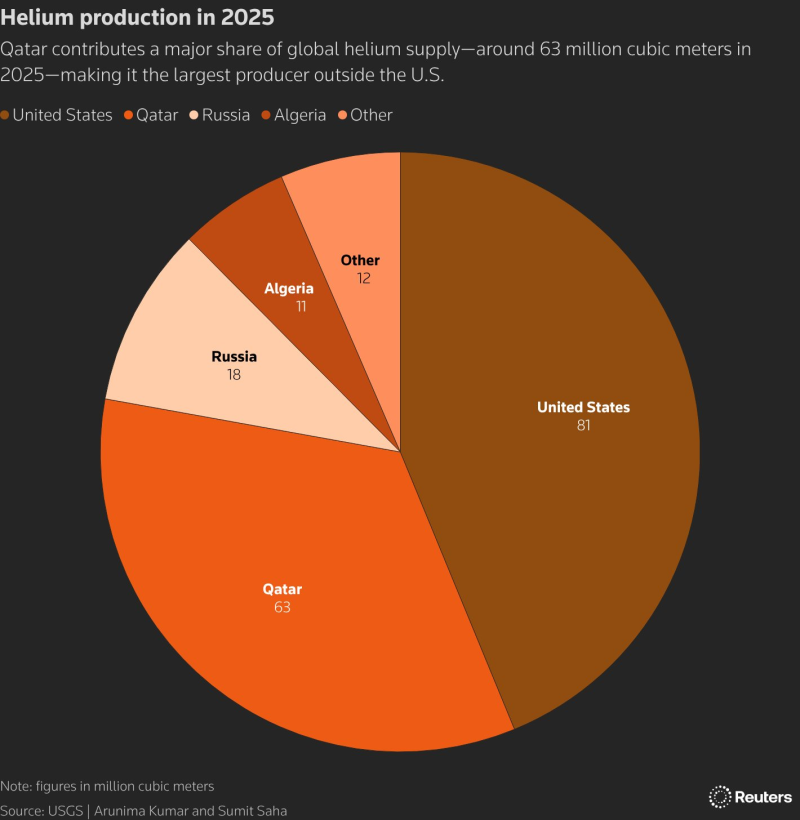
Qatar's 63 Million Cubic Meters of Helium Output Makes It Too Large to Replace Quickly
The Reuters production chart turns a geopolitical headline into a measurable supply problem. Global helium output is heavily concentrated: the United States leads at 81 million cubic meters, Qatar sits second at 63 million, and then the numbers drop off sharply. Russia comes in at 18, Algeria at 11, and all other producers combined at 12.
Qatar's output makes it too large to replace quickly. Even partial disruption can have an outsized effect on downstream industries given the gap between Qatar and the next-largest producers.
That concentration is the core vulnerability. There is no obvious swing producer waiting to absorb 63 million cubic meters of annual output on short notice. When supply from a source this large gets disrupted, the market doesn't rebalance smoothly. It scrambles.
TSMC, which projects 25% annual revenue growth through 2029 on AI chip demand, is among the producers most exposed to any input disruption that touches advanced fabrication processes.
Semiconductor Makers Face Allocation Risk as Healthcare Customers Get Prioritized
The immediate problem isn't a complete supply cutoff. It's allocation. Healthcare customers are being prioritized in the current rationing environment, while some industrial users are reportedly receiving only about half their normal monthly deliveries. For chipmakers, half-deliveries on a critical input aren't a minor inconvenience. They're a production constraint.
Helium shortages have started affecting tech supply chains, with executives describing reduced deliveries and force majeure declarations in the market.
Helium's role in semiconductor manufacturing goes beyond a single process. It's used for cooling, leak detection, and precision procedures that are difficult to substitute. Unlike some industrial inputs where alternative chemistries exist, helium's physical properties make it genuinely hard to replace in certain fabrication steps.
- United States: 81 million cubic meters (largest global producer)
- Qatar: 63 million cubic meters (now disrupted)
- Russia: 18 million cubic meters
- Algeria: 11 million cubic meters
- All others combined: 12 million cubic meters
NVDA and TSMC's Blackwell AI chip production in Arizona represents exactly the kind of advanced fabrication that depends on uninterrupted access to specialized industrial gases.
Helium Shortage Adds Invisible Bottleneck to Already Strained AI Chip Supply Chain
That timing is what makes this worth tracking. Demand for AI infrastructure hardware is running hot, lead times are already extended in parts of the supply chain, and now a concentrated industrial gas market is showing stress. The market response described in recent reports, a rush to lock in alternative supply including from US producers, signals that buyers are treating this as a real threat rather than a temporary blip.
China's AI chip restrictions have already put NVDA under pressure from the demand side. A helium disruption hitting the production side at the same time creates a more complicated operating environment for the entire semiconductor ecosystem.
The largest chipmakers will likely secure their allocations first. Smaller producers and those without long-term supply contracts absorb the delays. In that sense, helium has quietly joined the list of inputs where geopolitical exposure translates directly into manufacturing risk.
 Eseandre Mordi