Usman Salis

Oil prices have jumped sharply, yet bond markets are barely flinching. That gap between what crude is doing and how sovereign spreads are responding tells a story that goes beyond the headline price move. Michael J. Kramer flagged this divergence, noting that the muted response in the Italian-German 10-year spread suggests traders are skeptical that elevated oil prices will hold.
The chart that sparked the analysis compares light crude - now around $104.30 - with the Italian-German 10-year spread sitting near 77.72. One is pricing urgency. The other is signaling doubt.
Oil Surge at $104 Breaks Higher Without Spread Confirmation
The price action in crude is hard to ignore. Oil has moved in a near-vertical climb, the kind of sharp break that typically draws attention across asset classes. But the Italian-German 10-year spread has not followed. It remains volatile yet relatively contained, which is exactly the problem.
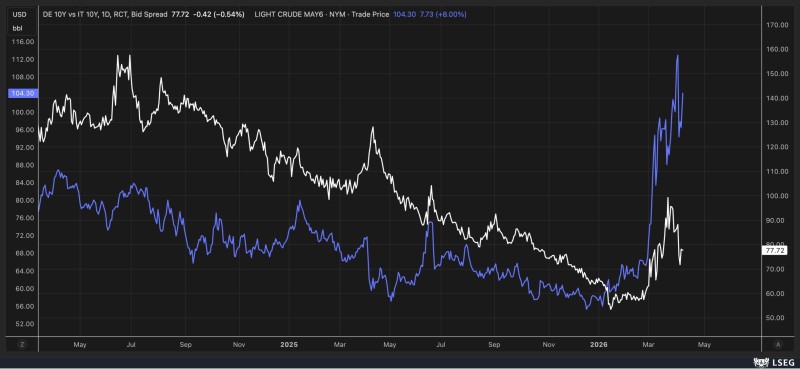
Cross-market confirmation is what separates a durable macro move from a sharp but ultimately short-lived spike. When oil rallies and sovereign spreads widen alongside it, markets are sending a unified message about inflation risk and macro pressure. Here, that unified message is missing.
The muted response in the spread suggests traders do not believe elevated oil prices will persist.
Instead of widening decisively with crude, the spread has held back. That hesitation is the core of the argument: oil is behaving as though something structurally important has changed, while bond markets are behaving as though the shock may pass.
Italian-German Spread Near 77.72 Signals Macro Doubt
The Italian-German 10-year spread is not a random data point. It functions as a useful stress gauge for how markets are pricing risk inside Europe. If oil were expected to stay elevated for any meaningful period, a stronger move in that spread would make sense - higher energy costs feed through to inflation, fiscal pressure, and growth concerns, all of which tend to push peripheral spreads wider.
WTI Oil Extends Rally Above $115 on Inflation Fears offers useful context for how this kind of sustained oil move has played out in previous cycles, when spread behavior was far less restrained.
Oil is moving as though conditions have structurally changed, while rates markets are behaving as though the shock may fade.
What the current chart shows is hesitation on the bond side. Oil has clearly broken out. The spread has not produced a matching breakout of its own. That leaves the rally looking isolated rather than confirmed - a sharp move still waiting for broader macro validation.
Oil Rally Looks Fast But Draws Little Market Conviction
The structure of this setup carries a clear implication: crude has won the headline battle, but it has not yet won the broader market argument. Investors appear to be treating the oil move as event-driven - something that may be real in the short term but is not yet trusted as the beginning of a lasting repricing cycle.
WTI Oil Pulls Back From $110-$115 Resistance as Momentum Fades shows how quickly that dynamic can reverse once confirmation fails to materialize.
That skepticism matters because markets tend to move more decisively when multiple asset classes tell the same story. Right now, oil is telling one story and bond spreads are telling another.
Until bond spreads start behaving as though higher energy prices are here to stay, skepticism will remain part of the story.
Among the signals worth watching in the near term:
- Whether the Italian-German spread begins widening to catch up with the crude move
- Whether oil holds above current levels or pulls back toward prior range
- Whether other risk-sensitive assets start pricing the same inflation concern crude is suggesting
Oil Hits Highest Weekly Close Since 2022 as Crude Tests $112 Resistance provides further historical context for how these breakout levels have behaved under similar cross-market conditions.
 Usman Salis