Peter Smith

Crude oil is entering a high-tension technical phase, with price action narrowing into a well-defined structure after a volatile move. Macro Liquidity by Sunil Reddy describes the current setup as a classic compression pattern - where the market is storing energy rather than committing to direction.
The Structure That Signals Crude Oil Compression
The 4-hour chart shows a clean symmetrical triangle, defined by a series of lower highs and higher lows.
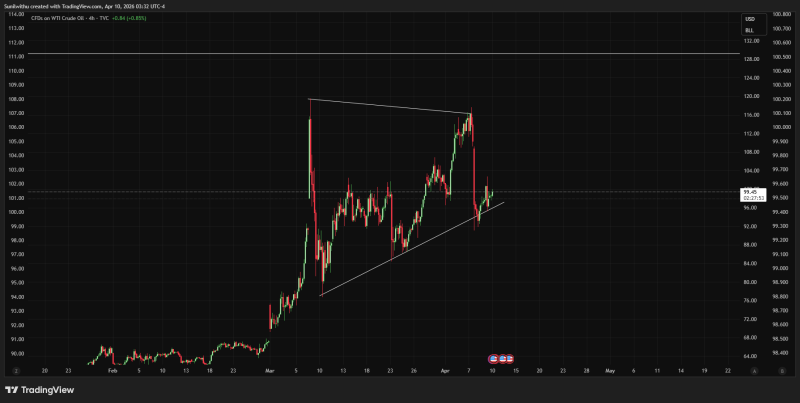
A descending trendline continues to cap rallies, while a rising trendline supports pullbacks, forcing price into a tightening range.
The market is in compression right now - volatility is declining as price approaches the apex, and each move becomes smaller while the significance of the eventual breakout only grows.
This type of structure reflects a market in compression, where volatility gradually declines as price approaches the apex. Each move becomes smaller, but the significance of the eventual breakout increases. Similar compression dynamics have historically preceded strong directional moves in crude oil, particularly when price oscillates between converging trendlines before resolving decisively - as detailed in this WTI crude oil breakout pattern analysis.
Liquidity Builds as Crude Oil Price Gets Trapped
Within the triangle, price action remains choppy and indecisive. Moves toward resistance are rejected, while dips into support are quickly absorbed, keeping the market locked near the middle of the range.
This behavior reflects liquidity building on both sides:
- Above the descending resistance, where breakout traders anticipate upside
- Below the rising support, where downside liquidity accumulates
- Around the midpoint, where false moves continue to trap participants
Short-term moves inside the triangle keep lacking follow-through - this phase is entirely about preparation, not direction. Both sides are loading up.
The result is a market environment where short-term moves lack follow-through, reinforcing the idea that the current phase is about preparation rather than direction. For broader context on where oil could move once it breaks free, see this USOIL analysis targeting $110-$120 resistance.
The Crude Oil Breakout Will Define the Next Move
The key signal lies not within the triangle, but in the moment price exits it. As the structure tightens, the probability of a sharp expansion increases.
Once a compression like this resolves, momentum tends to be swift and decisive - comparable oil structures have shown rapid acceleration toward the next major zone once the key level breaks.
Technical setups like this often resolve with strong momentum once a breakout is confirmed, particularly when preceded by sustained compression. For reference on nearby levels to watch, this WTI price analysis covering the $65.39-$69 range outlines the key zones in play.
For now, crude oil remains in a state of equilibrium - tightening, compressing, and building pressure. The longer this structure holds, the more significant the eventual breakout is likely to be.
 Peter Smith