Eseandre Mordi

⬤ The copper-to-oil ratio has stretched to an extreme - sitting roughly 2.5 standard deviations above its long-term trend. If the ratio simply moves back toward its historical mean, oil would outperform copper by almost 100% on a relative basis. Long-horizon charts with momentum indicators make it pretty clear: the current reading is well outside any normal range seen in recent cycles. For commodity watchers tracking copper's structural supply gap projected to hit 10 million tons by 2040, that context matters.
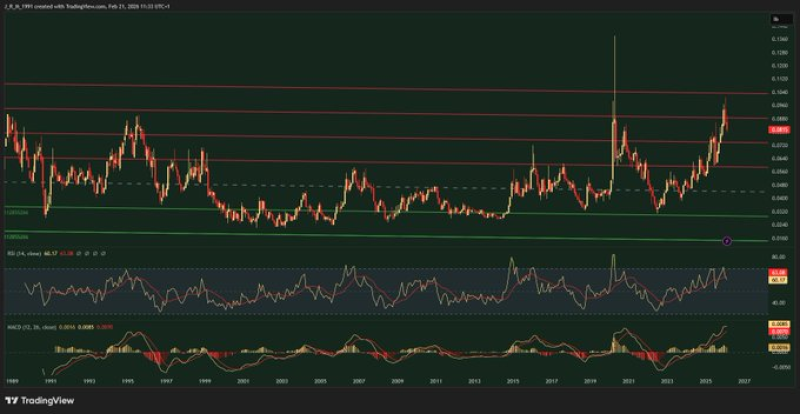
⬤ This isn't a bearish copper call. The author makes that explicit - copper's supply and demand picture remains supportive, with global copper demand on track to jump 50% by 2040 as supply falls short. The "catch-up" thesis is really about oil doing the heavy lifting if the ratio reverts, not copper collapsing. That's an important distinction - it keeps the trade firmly in cross-commodity relative-value territory rather than a bet on either market falling apart.
⬤ The positioning behind this view follows that logic directly. The author currently runs 45% exposure to energy within a commodity producer allocation, 35% in industrial metals, and 20% in precious metals. Meanwhile, WTI crude has broken $65.39 and is now eyeing the $68-$69 level - a technically driven move that lines up with the idea that oil still has room to run relative to copper.
⬤ With the ratio at a statistically stretched extreme, relative moves between energy and industrial metals could easily dominate commodity performance conversations in the months ahead. Whether the reversion comes through stronger oil prices, a steadier copper market, or both, the deviation itself signals a real imbalance - and markets tend to resolve those eventually.
 Eseandre Mordi