Usman Salis
Zeta Global Holdings Corp. is quietly building a case that's hard for growth investors to ignore. The marketing tech company just hit GAAP profitability while still growing revenue at nearly 30% year-over-year, a combination that doesn't show up every day. What makes ZETA particularly interesting right now is that existing customers keep spending more, not less. The company's net revenue retention sits at roughly 114%, meaning the platform is sticky enough that clients expand their usage over time.
From Growth Story to Earnings Machine
The shift to profitability changes everything. When a company crosses that line, earnings can scale faster than revenue because the infrastructure is already in place. ZETA's five-year revenue growth rate clocks in around 28.7%, and the trailing twelve months show similar momentum at 29.7%. Now layer in a forward P/E ratio between 16x and 18x based on updated guidance, and you start to see why some analysts think the valuation hasn't caught up yet. The price-to-sales ratio hovering around 3.5x adds another data point for those comparing ZETA to peers in the marketing analytics space.
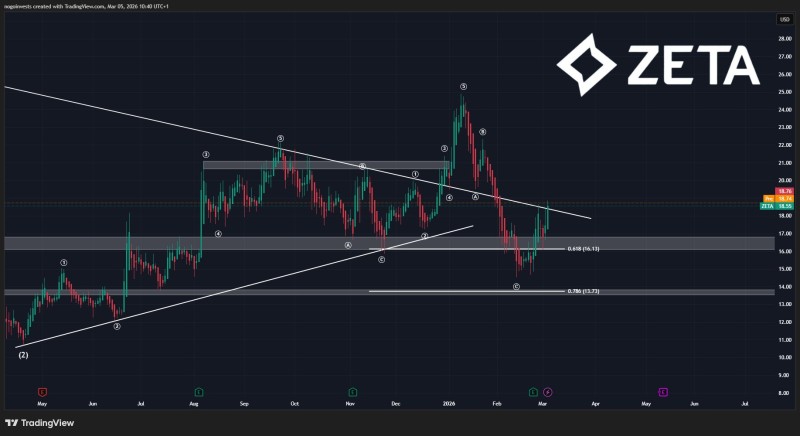
Behind the numbers sits a massive data engine. Zeta operates a first-party dataset covering about 552 million individuals and trillions of behavioral signals, which powers its AI-driven marketing platform. That scale matters in a world where third-party cookies are disappearing and advertisers need cleaner, consented data. Discussions around Zeta Global's technical structure ahead of 2026 have highlighted how the stock consolidated after earlier recovery phases, setting up potential breakout zones.
Volatility and Valuation Create Entry Debate
The stock hasn't moved in a straight line. After trading in the $20-$25 range, shares pulled back toward the mid-teens during broader market corrections. Some technical analysts noted patterns when ZETA tested 1.618 support following a 30% drop, while others pointed to bullish signals when ZETA jumped 16% on momentum triggers. The volatility reflects shifting sentiment, but the underlying fundamentals keep drawing attention from FinX platform users and institutional watchers alike.
As digital advertising becomes more data-driven, companies with scalable platforms and extensive first-party datasets are positioning themselves at the center of a structural shift. ZETA's combination of profitability, growth, and infrastructure puts it squarely in that conversation.
 Usman Salis