Usman Salis
Daniel Romero points out that NVDA has been range-bound for the better part of eight months, reinforcing the idea that the broader AI stock market trend may be losing steam. The stock is no longer trending - it's consolidating, and that distinction matters more than most people realize.
When NVDA's 100% AI Rally Hit a Ceiling
The chart tells a clean story. From early 2025, Nvidia climbed from below $100 to nearly $200, printing a textbook sequence of higher highs and higher lows. That was the momentum phase - the part of the move where every dip got bought and every breakout held.
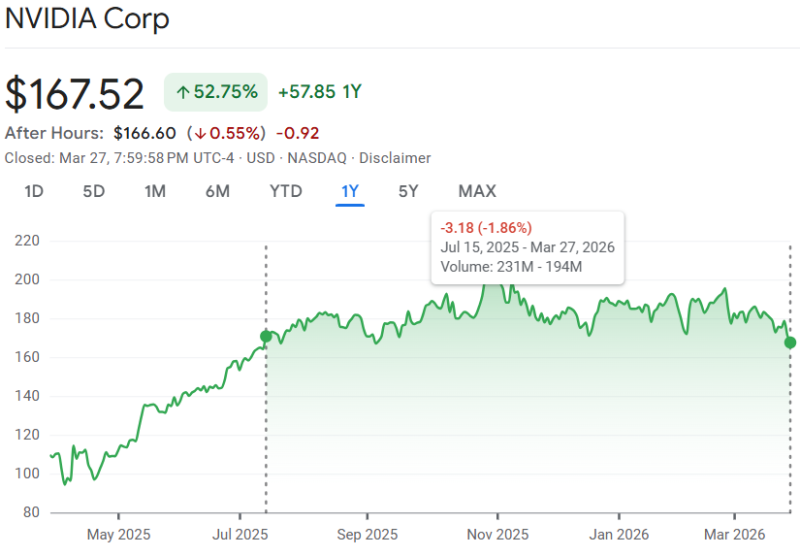
Then, around mid-2025, something changed. The stock stopped making new highs. Instead of continuation, you got compression - price wedged into a $165-$195 range and hasn't left since.
The stock is no longer accelerating higher. While still up significantly on a yearly basis, the price action has shifted from trend to equilibrium.
Still impressive on a yearly basis? Yes. But the character of the move is completely different now.
NVDA's $165-$200 Range: The Structure That's Defining the Market
For the best AI stocks to build a long-term portfolio around, consolidation after a major run is actually normal - but the specifics here are worth paying attention to.
Over the past eight months, Nvidia has repeatedly tested the $190-$200 zone and repeatedly failed to close above it with any conviction. Meanwhile, every drop toward $165-$170 has attracted buyers willing to step in.
That gives you a well-defined range with two clear boundaries:
- Resistance sitting just under $200, with multiple failed breakout attempts stacking up
- Support built into the $165-$170 area, holding back any serious downside
The repeated rejections at the top confirm that buying pressure has softened. The consistent holds at the bottom confirm that sellers haven't taken over either. It's a standoff.
Pause, Not Breakdown: What the NVDA Price Structure Actually Signals
This doesn't look like a top. It looks like digestion.
Nvidia's insider activity heading into earnings has added some noise around the stock, but the broader price structure is consistent with what you'd expect after a major trend - a period where the market works through overhead supply before deciding on its next move.
Eight months of sideways movement following a major rally is a structural shift - the key takeaway is not just performance, it's duration.
Nvidia still anchors the AI narrative. Its GPU infrastructure dominance isn't going anywhere, and long-term expectations remain intact. But even the strongest trends need to breathe.
The absence of new highs over several months means the previous momentum phase is over. What's replaced it is a slower, more balanced environment where buyers and sellers are roughly matched.
The NVDA Breakout or Breakdown: What Traders Are Watching Next
The setup is binary from here. As Romero framed it, the duration of this consolidation is the signal - and the resolution will set the tone for whatever comes next.
The longer the stock stays compressed, the more meaningful the eventual move is likely to be.
For traders, the levels are straightforward:
- A clean breakout above $200 would signal trend resumption and bring in momentum buyers
- A breakdown below $165 would mark a structural shift and open the door to a deeper correction
Nvidia's position as 16% of U.S. GDP makes this more than just a stock story - it's a read on the entire AI trade. Until one of those levels breaks, NVDA stays locked in range. The trend has paused. But eight months of compression doesn't unwind quietly.
 Usman Salis