Saad Ullah

Mercedes-Benz is navigating a split trajectory. While battery electric vehicle sales showed a modest increase to 50,400 units in Q1 2026, overall vehicle sales continue to decline - reinforcing a broader contraction in the company's performance.
The Mercedes BEV Uptrend That Lost Momentum
The BEV sales chart shows a strong upward trajectory from 2021 through late 2023, with quarterly volumes rising from below 20,000 units to a peak near 65,000 units in Q4 2023.
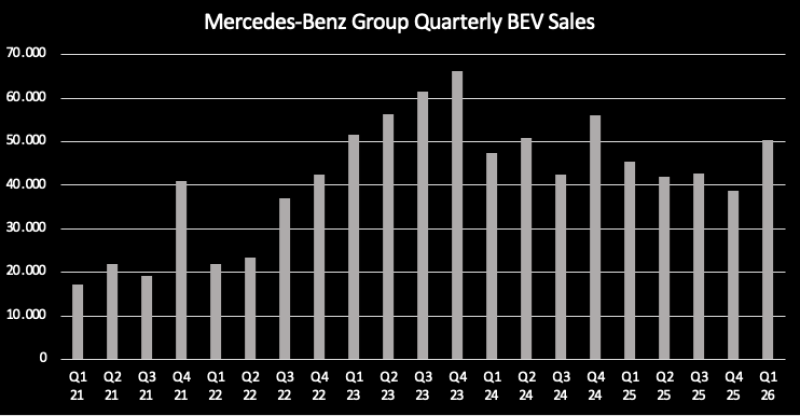
As Alex noted, BEV sales increased 11% year-over-year in Q1 2026. However, the structure has clearly shifted since the peak:
- The prior uptrend stalled after Q4 2023
- Lower highs formed throughout 2024 and into 2025
- Recent data shows stabilization rather than renewed expansion
A Mercedes EV Range Defined by Failed Breakouts
Following the late-2023 high, BEV sales pulled back sharply into early 2024, dropping below 50,000 units. While there were temporary recoveries - including a rebound toward ~55,000 units - the chart shows repeated failure to reclaim the 60,000-65,000 range. That zone now acts as a clear ceiling.
On the downside, the 40,000-45,000 range has repeatedly held, forming a support band where declines have stabilized. The latest Q1 2026 figure near 50,400 units sits mid-range, reinforcing the idea of consolidation rather than directional growth.
Regional Mercedes Sales Divergence Adds to the Pressure
The broader sales data highlights uneven performance across regions. Global vehicle sales fell 6% in Q1, with sharp declines in key markets:
- China dropped 27%
- Asia declined 23%
- Europe increased 7%
- U.S. rose 20%
Despite strength in Western markets, weakness in China and Asia continues to dominate the overall trend. For full-year 2025, vehicle sales declined 9% - underscoring a persistent contraction that Western market gains cannot fully offset.
Despite a 20% rise in U.S. sales and 7% growth in Europe, a 27% drop in China is large enough to overwhelm Western strength and pull the global total decisively lower.
CEO of Benz: How Ola Källenius Rose From Analyst to Lead Mercedes-Benz provides context for the strategic decisions shaping Mercedes-Benz's response to this environment - where the long-term electric transition ambition is running into near-term volume and market-share headwinds simultaneously.
Mercedes Still in Contraction Mode Despite EV Bounce
Beyond sales figures, internal restructuring reflects the same trend. Around 5,500 employees left the company between April 2025 and March 2026 as part of a cost-cutting program - a structural adjustment that mirrors the sales contraction visible in the chart.
The chart captures the broader picture clearly: EV growth has plateaued well below its 2023 peak, total sales are declining across the most important markets, and the prior growth phase has not returned. Instead of expansion, Mercedes-Benz appears to be managing through a contraction phase - one where stabilization rather than acceleration defines the near-term trajectory.
 Saad Ullah