Eseandre Mordi
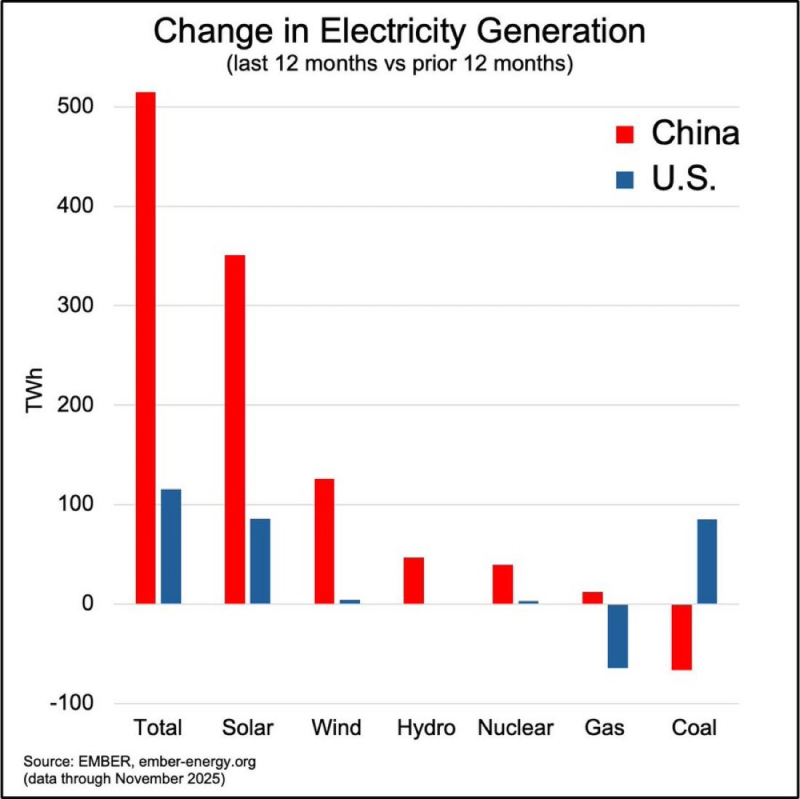
⬤ China added more than 500 terawatt-hours of electricity generation over the past year while US growth remained minimal, creating a strategic challenge for America's technology sector. The data reveals China expanding capacity across solar (350 TWh), wind (120 TWh), hydro, and nuclear, while US growth stayed concentrated in solar (80 TWh) with declining natural gas output. This energy gap is becoming a critical bottleneck for AI development and data center expansion.
⬤ The divergence hits particularly hard for artificial intelligence infrastructure, which demands massive amounts of reliable power. "While the U.S. leads in advanced semiconductors such as NVDA, energy capacity has become a critical limiting factor," highlighting how chip design leadership doesn't translate to compute deployment without adequate electricity supply.
⬤ The contrast matters because electricity is now foundational for competitiveness in AI, cloud computing, and advanced manufacturing. China appears to be aligning energy expansion with long-term industrial needs, while the US faces capacity constraints that could determine where large-scale computing infrastructure gets built. Despite maintaining semiconductor leadership through companies like NVDA, persistent energy generation gaps may increasingly shape technological outcomes and economic positioning going forward.
 Eseandre Mordi