Editorial staff
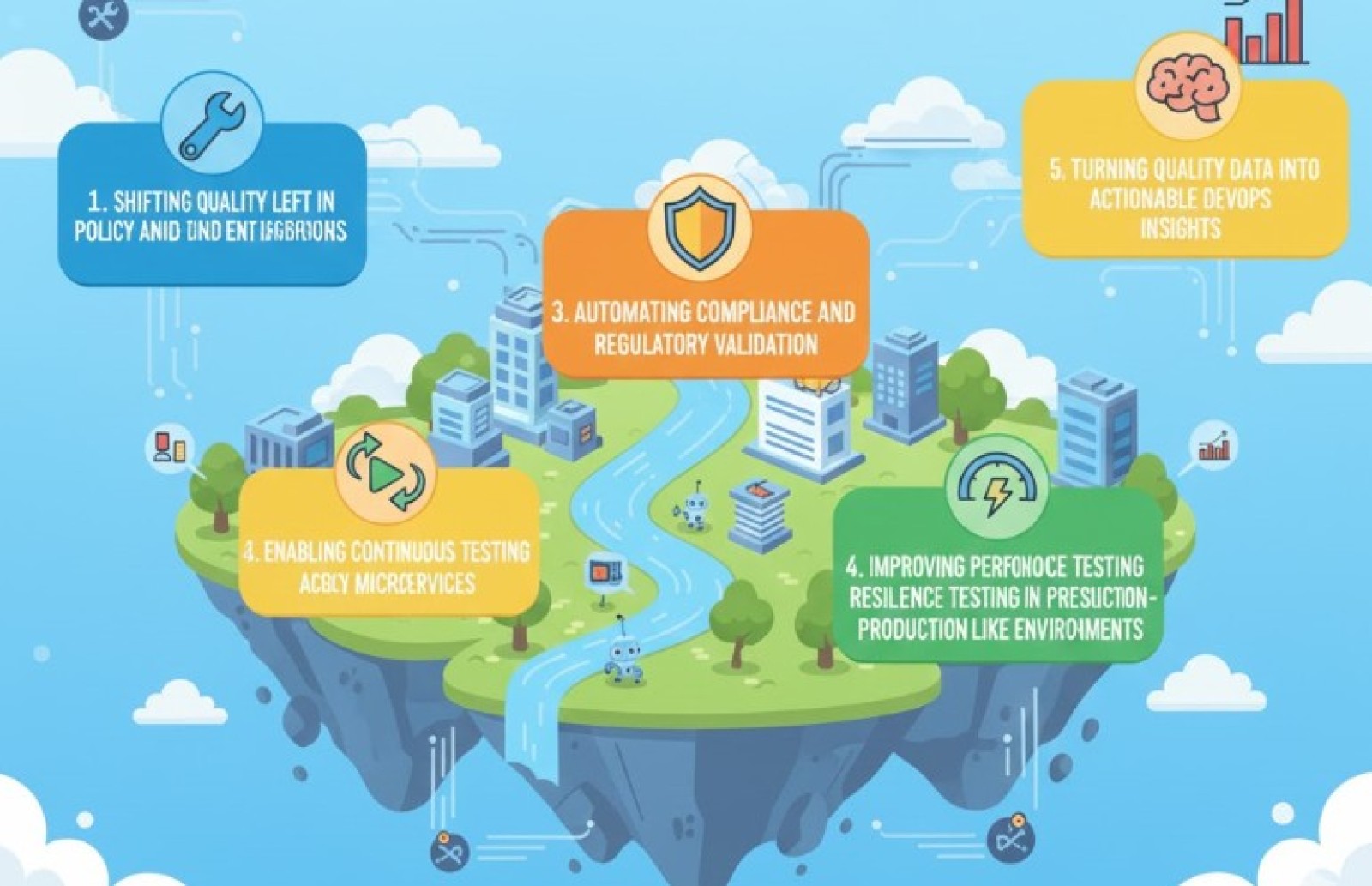
- 1. Moving Quality Left in Product and Policy Development.
- 2. Facilitating Continuous Testing Among Microservices and APIs.
- 3. Robotizing Compliance and Regulatory Checking.
- 4. Enhancing Performance and Resilience Testing at Production-Like Schemes.
- 5. Transforming Quality Data to DevOps Actionable Insights.
- Summary: Quality as a Platform Capability.
By- Kiran Babu Boddapati.
Property and Casualty (P&C) insurers are rapidly modernizing their core platforms to support digital distribution, real-time underwriting, usage-based pricing, and faster claims processing. As monolithic policy and claims systems give way to cloud-native, microservices-based architectures, traditional quality assurance models are no longer sufficient. Manual testing cycles, late-stage validation, and siloed QA teams struggle to keep pace with continuous releases and complex integrations. In response, insurers are embedding quality engineering (QE) directly into DevOps pipelines, transforming quality from a gatekeeping function into a continuous, automated capability. Here are five key ways this shift is reshaping cloud-native P&C insurance platforms.
1. Moving Quality Left in Product and Policy Development.
Defects in product configuration-rates, rules, coverages and endorsements were not usually discovered until later in the release cycle, causing delays and production problems in legacy P&C platforms. Testing was usually end-to-end validation of the work once it had been developed. QE using DevOps transfers quality left by integrating automated validation in build and deployment pipelines. Code tests are done to test configuration changes, rule validation tests are done, rating accuracy tests are run and regression tests are also run automatically. This enables the insurers to launch new products and pricing model more quickly and minimize the underwriting and compliance risk.
2. Facilitating Continuous Testing Among Microservices and APIs.
Cloud P2C platforms are based on microservices and APIs to interface policy, billing, claims, fraud and third party data providers. The traditional QA models were prone to integration problems to be revealed in testing or production of the system. Incorporating QE into the DevOps, insurers apply the principle of continuous testing of the APIs and the contracts. Mocks, stubs and consumer-driven contracts are used to validate service dependencies so that any changes in one service will not cause downstream systems to break. This is a strategy that enhances platform resiliency and promotes frequent, low-risk deployments.
3. Robotizing Compliance and Regulatory Checking.
The operational P&C insurers are subject to stringent regulatory requirements that differ across jurisdiction, product line and type of coverage. Historically, the compliance testing is manual, document-intensive, and not linked to the development processes.
QE built in DevOps facilitates compliance testing, since regulation rules, data checks, and audit checks are built directly into pipelines. Evidence of tests is created automatically, and traceability is enhanced, which saves more effort on audits. This makes sure that cloud-native platforms are kept in line as releases become more frequent.
4. Enhancing Performance and Resilience Testing at Production-Like Schemes.
The extreme load of P&C systems might be caused by policy renewal, catastrophe events, and claims surges. The traditional performance testing that was done in rare conditions and situations was not very successful in representing the conditions of the real world. The current state of QE includes continuous performance and resilience testing as part of DevOps processes. Load, stress, and chaos tests are performed in production-like settings in order to test scalability and fault tolerance.
5. Transforming Quality Data to DevOps Actionable Insights.
QA models used in silo considered the test results as pass/fail and had little visibility into the problems within the system. This ensured that quality could not be proactively enhanced. QE that has been integrated with DevOps converts quality data to continuous feedback loops. The test measures, defect trends, and pipeline health trends are distributed throughout the development, operations and product teams.
Summary: Quality as a Platform Capability.
In cloud-native P/C insurance solutions, quality cannot be an add-on, or a distinct step anymore, but rather it needs to be built into all the delivery steps. Incorporating quality engineering in DevOps, insurers are developing platforms that are facilitated to change faster, are safer to operate and are easier to govern. What is created is not only superior software but more robust insurance processes capable of responding swiftly to the market needs, change in regulations and customer expectations.
 Editorial staff